


Table of Contents
- What Makes a Great Adjustable Resistance Bar
- Full-Body Resistance Bar Exercises You Can Do at Home
- Resistance Bar vs Dumbbells for Home Gym: Which Works Better
- How to Increase Grip Strength with Resistance Bars
- Durability, Maintenance, and Longevity
- Space-Saving Storage Solutions for Portable Fitness
- Safety Considerations and Who Should Use Resistance Bars
- Frequently Asked Questions
Last Updated: September 30, 2026
What Makes a Great Adjustable Resistance Bar
An adjustable resistance bar is a portable fitness tool that delivers variable tension through a twisting mechanism, allowing you to customize workout intensity without swapping equipment. Unlike fixed-resistance bands or dumbbells, these bars let you dial in exactly the resistance level you need, whether you're recovering from injury, building strength, or maintaining fitness while traveling.
The best adjustable resistance bars share three core qualities: smooth tension adjustment, ergonomic hand grips, and reliable durability. When you're choosing between options, these factors determine whether the bar becomes a daily habit or collects dust.
What separates a great bar from a mediocre one comes down to build quality and grip design. A bar that requires excessive force to adjust tension frustrates users and discourages consistent use. Hand grips matter more than most people realize, arthritis, weak grip strength, or hand sensitivity can make an uncomfortable bar unusable, even if the resistance range is perfect. The best models use anti-slip, ergonomic handles that feel secure whether your hands are dry or slightly sweaty.
Durability and maintenance are equally critical. A bar that loosens over time, develops squeaks, or loses tension adjustment smoothness becomes unreliable. Heavy-duty construction with quality materials ensures the bar performs consistently across hundreds of workouts.
Full-Body Resistance Bar Exercises You Can Do at Home
Adjustable resistance bars enable full-body workouts in a space smaller than a yoga mat. Standing, sitting, or lying down, you can target every major muscle group with simple, joint-friendly movements.
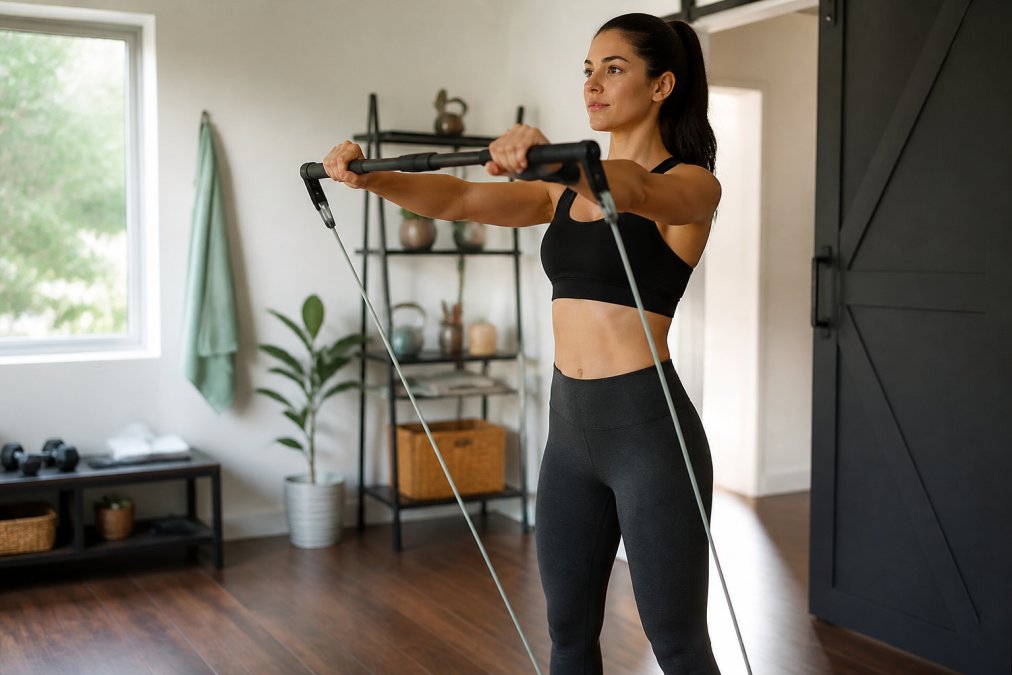
Start with chest presses: stand with feet shoulder-width apart, hold the bar at chest height, and push forward against the resistance. This targets your chest, shoulders, and triceps. Adjust tension by twisting the bar, higher tension increases difficulty. Most people find 3 sets of 12-15 reps builds strength without overloading joints.
Bicep curls work well for arm strength. Hold the bar at waist height with palms facing up, bend your elbows, and curl upward. The resistance bar provides constant tension throughout the movement, which many people find more effective than free weights for muscle activation.
Overhead presses develop shoulder stability. Hold the bar at shoulder height and press straight up. This movement builds core stability alongside shoulder strength, your core engages to stabilize your spine against the resistance.
Seated exercises expand your options. Seated rows strengthen your back: sit upright, hold the bar at chest level, and pull toward your body. For core work, sit on the floor with legs extended, hold the bar across your chest, and rotate side to side. These seated movements are especially valuable for desk workers or anyone with limited standing balance.
Leg exercises using the bar include squats (hold it overhead or at chest level for added resistance) and lunges (hold it at chest height for balance and added load). Many people overlook lower-body work with resistance bars, but these movements build leg strength and stability effectively.
The key to a full-body program: rotate between upper body, lower body, and core work across your week. Three 20-minute sessions spread across the week beats sporadic longer sessions.
Resistance Bar vs Dumbbells for Home Gym: Which Works Better
Both resistance bars and dumbbells build strength, but they excel in different situations, and for many people, the resistance bar wins on practicality.
Dumbbells require multiple pairs to progress through weight increases. A basic home dumbbell set costs more and occupies significantly more space. Adjustable resistance bars deliver the same progressive overload with a single piece of equipment and a footprint the size of a broomstick.
Dumbbells excel at isolation exercises and explosive movements. If you want to perform heavy barbell-style lifts or single-arm work, dumbbells are superior. But for controlled strength training, rehabilitation, and full-body workouts in tight spaces, resistance bars outperform dumbbells.
The resistance bar's constant tension throughout the movement, rather than the gravity-dependent tension of dumbbells, creates different muscle activation patterns. Many people report feeling muscles work harder with resistance bars, particularly in the eccentric (lowering) phase.
For travelers, office workers, and anyone with space constraints, the resistance bar is the practical choice. You can pack a bar in a carry-on bag and maintain your full workout routine anywhere. Try fitting a dumbbell set in a suitcase.
Grip strength development favors resistance bars. Holding and twisting the bar to adjust tension builds hand and forearm strength in ways dumbbells don't. For seniors or anyone concerned about grip strength, this advantage matters significantly.
Cost-wise, a quality adjustable resistance bar typically costs less than a basic dumbbell set.
How to Increase Grip Strength with Resistance Bars
Grip strength predicts overall health and longevity, research consistently shows that hand strength correlates with functional independence in aging (pubmed.ncbi.nlm.nih.gov).
The twisting mechanism itself strengthens your hands. Every time you adjust tension, you're performing a gripping, twisting movement that engages your forearms, wrists, and hand muscles. Over weeks of regular use, this translates to noticeably stronger grip.
Dedicated grip-focused exercises amplify the effect. Farmer's carries, holding the bar at your sides and walking, build grip endurance. Isometric holds, gripping the bar at a fixed tension for 30-60 seconds, develop maximum grip strength.
Combine resistance bar training with targeted grip work for faster results. The PowerGrip Strength Trainer at Health&Wellness (starting at $26.19) pairs perfectly with resistance bar training, allowing you to focus specifically on hand strength while the bar handles full-body work.
Progression matters. Start at a comfortable resistance level and gradually increase tension as your grip strengthens. This progressive overload principle applies to grip training just as it does to other strength work.
For seniors or anyone recovering from hand surgery or arthritis, grip strength training with resistance bars offers a safe, low-impact path to functional improvement. The adjustable tension means you can start light and advance at your own pace.
Durability, Maintenance, and Longevity
A quality resistance bar lasts years with minimal maintenance. The key factors determining longevity are material quality, proper storage, and occasional cleaning.
Heavy-duty construction with premium materials resists wear. Bars made from durable PP or high-grade materials withstand hundreds of workouts without loosening, squeaking, or losing tension adjustment smoothness. Cheaper alternatives often develop play in the twisting mechanism within months.
Storage matters more than most people realize. Keep your bar in a cool, dry location away from direct sunlight. UV exposure degrades materials over time. Avoid storing the bar in extremely hot environments (like a car trunk in summer) or damp spaces (like a garage prone to humidity). A simple gym bag or closet shelf keeps your bar protected.
Cleaning is straightforward. Wipe down the bar with a dry cloth after workouts, especially if you've perspired. For deeper cleaning, use a slightly damp cloth with mild soap, then dry completely. Never soak the bar or use harsh chemicals, these can damage the material and the twisting mechanism.
Check the tension adjustment periodically. If you notice the bar becoming harder to twist or losing tension hold, the mechanism may need attention. Most quality bars maintain consistent performance for years before any adjustment is needed. This is where premium construction separates reliable bars from budget options that deteriorate quickly.
The best resistance bars come with warranties backing durability claims. This tells you the manufacturer stands behind their product. Health&Wellness products are built for long-term use, supporting your fitness goals whether you're exercising at home, in the office, or traveling.
Space-Saving Storage Solutions for Portable Fitness
One of the biggest advantages of adjustable resistance bars is their minimal footprint. This makes storage trivial compared to dumbbells, kettlebells, or other home gym equipment.
Vertical storage works best. Lean your bar in a corner of a closet, behind a door, or in a wall-mounted rack designed for yoga mats. This keeps it visible and accessible without consuming floor space. Many people store their bar alongside yoga mats and stretching straps, they occupy the same footprint.
A simple gym bag or equipment case protects your bar during travel while keeping it organized at home. Rolling storage containers designed for yoga equipment work perfectly. The bar fits inside with room to spare, and you can toss in other portable fitness items like resistance bands or jump ropes.
Wall-mounted hooks or magnetic strips designed for fitness equipment offer another option. Mount a hook at eye level in your home office or bedroom, and your bar hangs ready to grab for quick workouts. This visibility actually increases usage, you're more likely to exercise when your equipment is in plain sight.
For apartment dwellers and anyone with minimal space, resistance bars are ideal. The Compact Pilates Sliding Board at Health&Wellness (starting at $274.40) pairs well with a resistance bar for a complete home gym that fits in a closet.
Safety Considerations and Who Should Use Resistance Bars
Adjustable resistance bars are remarkably safe for most people, but certain considerations matter.
Frequently Asked Questions
Are adjustable resistance bars effective for muscle building?
Yes. Adjustable resistance bars deliver progressive strength training through variable tension adjustment. You control the resistance level by twisting the bar, allowing you to increase intensity as your fitness improves. This makes them suitable for building muscle across the chest, shoulders, arms, and core. The ergonomic hand grips and adjustable tension system support consistent, joint-friendly workouts that improve muscle tone and endurance over time.
How do I choose the right resistance level for a resistance bar workout?
Start with a lower resistance setting and perform 10-15 repetitions. If the movement feels too easy, increase tension; if you cannot complete the reps with proper form, reduce it. Most adjustable resistance bars offer a wide resistance range (for example, the PowerGrip Strength Trainer ranges from 10 kg to 60 kg), so you can adjust as your fitness level improves. Choose a level where the final 2-3 reps feel challenging but achievable.
Can you use an adjustable resistance bar for full-body workouts?
Absolutely. Adjustable resistance bars work for standing, sitting, and lying-down exercises, targeting multiple muscle groups including chest, shoulders, arms, back, and core. You can perform pressing movements, rows, lateral raises, and core stability exercises. This versatility makes them ideal for home gym setups where space is limited but full-body training is your goal.
What makes an adjustable resistance bar suitable for seniors and people with arthritis?
Resistance bars with ergonomic, anti-slip handles reduce strain on arthritic joints compared to free weights. The smooth, controlled tension adjustment allows seniors to start at very low resistance levels and progress gradually. Joint-friendly resistance bars enable seated or supported exercise, making them safer for limited mobility. Always consult a healthcare provider before starting any new exercise program, especially if you have arthritis or mobility concerns.


