


Table of Contents
- Why Seated Resistance Exercises Improve Mobility
- Setting Up Your Resistance Band for Seated Work
- Seated Resistance Band Exercises for Mobility
- Chair Exercises for Seniors: Progressions and Regressions
- 10-Minute Seated Workout Routine for Daily Mobility
- Resistance Band Exercises for Seniors: Safety and Pain Management
- Tracking Progress and Building a Sustainable Mobility Plan
- Frequently Asked Questions
Last Updated: October 11, 2026
Why Seated Resistance Exercises Improve Mobility
Seated resistance exercises use bands, bars, or other tools to build strength and flexibility while sitting. They help people move better, whether recovering from injury, managing arthritis, or staying active as you age.
Resistance work strengthens the muscles that support your joints, reducing pain and improving control. You also expand your range of motion, the distance your joints can move in different directions.
Seated work removes balance concerns since you're already supported by the chair, letting you focus on the movement itself. This makes seated resistance exercises safer for older adults and anyone with limited mobility.
You need only a sturdy chair and a resistance band to start building strength.
Setting Up Your Resistance Band for Seated Work
Your setup matters: the right chair, the right band resistance, and safe anchoring make every movement more effective.
Choosing the Right Chair
Your chair is your foundation. A wobbly chair forces your core to work overtime, pulling focus from the movement.
Chair height: Your feet should rest flat on the floor with knees at 90 degrees. If feet dangle, use a footrest.
Chair back: A chair with back support is ideal, supporting your mid-back. When doing upper-body resistance work, the chair back keeps you from tipping backward.
Chair stability: Test the chair before starting, push the armrests and lean back. If it wobbles, find a different chair.
Armrests (optional): Armrests help when standing or sitting, especially if you have limited grip strength or balance concerns.
Choosing the Right Resistance Level
Start light.
The right resistance should let you complete 12-15 repetitions with good form. The last two or three reps should feel harder than the first few, but you should never lose control or have to hold your breath.
Light bands: Building initial strength, practicing form, recovering from injury, upper-body work, or new to training.
Medium bands: Maintaining gains after 3-4 weeks, building endurance, lower-body work, or prior exercise experience.
Heavy bands: Advanced strength building after 8+ weeks of consistent training, or lower-body movements needing more challenge.
With the Probar-Stretchbandplus, adjust resistance by twisting the bar. Start with minimal tension.
Safe Anchoring and Band Placement
Your band must be secure before you start moving.
For upper-body work: Loop around a sturdy chair leg, wrap around a door frame at mid-back height, hold under your foot, or use a door anchor.
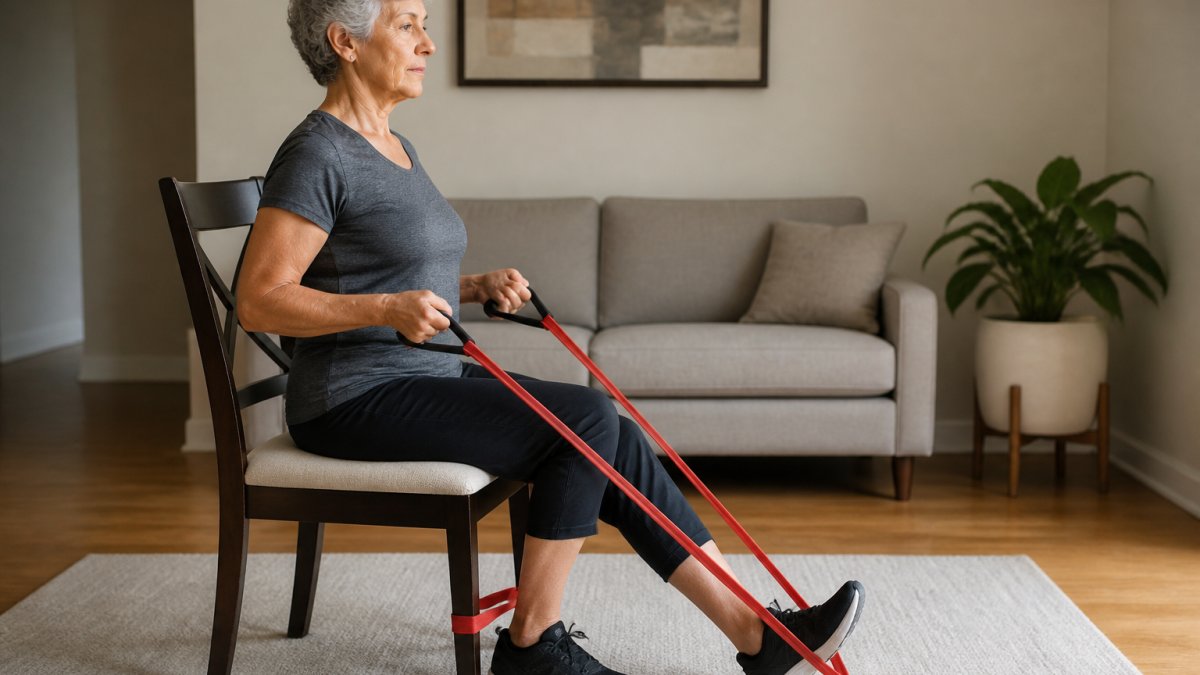
For lower-body work: Wrap around the chair leg, use a resistance loop around both legs, hold with your hands, or anchor around a sturdy table leg.
Always check your anchor point before adding tension. Pull gently to confirm it won't slip. A moving anchor point ruins your form and can cause injury.
Band placement: The band should sit comfortably on your skin or light clothing. Avoid bare skin on sensitive areas like wrists, tops of feet, or inner thighs.
Adaptations for Limited Grip, One-Sided Movement, or Arthritis
If you have arthritis, limited grip strength, or movement on one side of your body, these adaptations make exercises accessible:
Limited grip strength: Wrap the band around your forearm or wrist, use a thicker band, anchor so you press without gripping, or use a resistance loop.
One-sided movement: Perform unilateral exercises with lighter resistance on the affected side, do more reps on that side, and use your stronger side to assist if needed.
Arthritis or joint pain: Warm up 2-3 minutes, use lighter resistance and higher reps (15-20), reduce range of motion if needed, keep a slight bend in joints, and stop if you feel sharp pain.
Foot Placement and Core Engagement
Your feet anchor your lower body and stabilize your spine.
Foot placement: Keep both feet flat on the floor, about hip-width apart, with weight distributed evenly. For single-leg exercises, keep your non-working foot flat for stability.
Core engagement: Before upper-body movements, gently tighten your abdominal muscles to create a stable foundation for your spine, preventing excessive lower-back arch.
Seated Resistance Band Exercises for Mobility
These movements target joints and muscles that limit daily movement. Perform each slowly with full control; quality matters more than speed.
Upper-Body Mobility Movements
Seated Chest Press with Band
Sit upright with your back against the chair. Loop the band behind you at mid-back height. Hold both ends at chest level. Press forward, extending your arms fully. Hold one second, then return. Complete 12-15 repetitions.
Seated Shoulder Rows
Anchor the band in front at shoulder height. Hold both ends with arms extended. Pull toward your chest, squeezing shoulder blades together. Return to start. Complete 12-15 repetitions. Rows build upper-back strength and improve reaching and lifting.
Seated Arm Circles with Light Resistance
Hold a light band at shoulder height. Make small circles forward for 10 reps, then backward for 10 reps, keeping movements controlled and core engaged. Arm circles improve shoulder mobility and stability.
Lower-Body Seated Movements
Seated Leg Extensions
Sit upright. Loop a band around one foot and hold the other end. Straighten your leg forward against resistance. Hold one second, then return. Complete 12-15 reps, then switch legs.
Seated Hamstring Curls
Sit upright. Anchor the band in front of you at ankle height. Loop it around one foot. Pull your heel toward your buttocks against the resistance.
Hamstring curls improve hip flexibility.
Seated Calf Raises with Band Assistance
Sit upright with feet flat. Loop the band around one foot and hold both ends. Press your toes downward against resistance. Hold one second, then return.
Chair Exercises for Seniors: Progressions and Regressions
Your routine should match your current fitness level and adapt as you improve.
Understanding Readiness to Progress
Before progressing, ask: Did I complete all reps with good form? Could I have done 2-3 more? Did the movement feel easier than two weeks ago? Did I have pain? If yes to the first three and no to the fourth, you're ready to progress.
Regression Strategies (Easier Versions)
Regress when you're new to training, recovering from injury, experiencing pain, can't complete 8 reps with good form, or returning after a break of more than two weeks.
Reduce resistance: Switch to a lighter band or try the movement without a band.
Reduce range of motion: Press only halfway or extend only three-quarters of the way. Partial movements build strength while reducing joint stress.
Reduce repetitions: Drop from 12-15 reps to 8-10 reps or complete fewer sets.
Reduce hold time: Reduce from one second to a half-second or eliminate the hold.
Switch to bodyweight: Seated marches, arm circles, and torso twists require no equipment and are excellent regressions.
Example progression for seated leg extensions:
- Week 1-2: Bodyweight, 8 reps each leg
- Week 3-4: Light band, 10 reps each leg
- Week 5-6: Light band, 12 reps each leg, 1-second hold
- Week 7-8: Medium band, 12 reps each leg, 1-second hold
Progression Strategies (Harder Versions)
Progress one variable at a time. Options: move from light to medium band, add 2-3 reps, increase hold time to two seconds, expand to full range of motion, add a third set, or slow down the movement to two seconds per direction.
Example progression for seated chest press:
- Week 1-2: Light band, 12 reps, 1-second hold, 2 sets
- Week 3-4: Light band, 15 reps, 1-second hold, 2 sets
- Week 5-6: Medium band, 12 reps, 1-second hold, 2 sets
- Week 7-8: Medium band, 12 reps, 2-second hold, 3 sets
The Deload Week
Every 4-6 weeks, reduce resistance or reps by 25-30% for one week. This gives joints and connective tissues time to recover and prevents overuse injuries. Example: If doing medium band with 15 reps, deload week would be light band with 10-12 reps.
Plateaus and How to Break Through Them
If the same routine feels unchallenging after 8+ weeks, you've hit a plateau. To break through: change exercise order, add a new exercise for the same muscle group, increase hold time, add a set, or switch from band to bodyweight. Plateau is normal and means your body is ready for a new challenge.
10-Minute Seated Workout Routine for Daily Mobility
This routine takes 10 minutes and targets all major joints. Perform it three times per week on non-consecutive days.
| Exercise | Duration | Reps |
|---|---|---|
| Seated arm circles | 1 minute | 10 forward, 10 back |
| Seated chest press with band | 1.5 minutes | 12-15 reps |
| Seated shoulder rows | 1.5 minutes | 12-15 reps |
| Seated leg extensions | 2 minutes | 12-15 each leg |
| Seated hamstring curls | 2 minutes | 12-15 each leg |
| Seated calf raises | 1 minute | 12-15 each foot |
| Seated forward fold | 1 minute | Hold 30 seconds, repeat 2 times |
Rest 30 seconds between exercises. Move slowly and focus on control, not speed.
Resistance Band Exercises for Seniors: Safety and Pain Management
Safety comes first. Learn to recognize the difference between muscle fatigue and joint pain.
Screening Before You Start
Before starting, ask: Do you have arthritis, joint pain, or previous injuries? Have you been sedentary for more than six months? Do you take medications affecting balance? Have you had surgery in the past year? If yes to any, talk to your doctor. Also test your current range of motion: Can you reach overhead? Touch your toes while seated? Stand from a chair without using your hands?
When to Stop or Modify
Stop immediately if you feel sharp pain, tingling, numbness, dizziness, or pain lasting 30+ minutes. Modify if you feel mild joint discomfort, fatigue affecting form, or swelling. Modification means using lighter resistance, reducing range of motion, or switching exercises. Warming up 2-3 minutes before resistance work helps many people with arthritis or joint issues.
Tracking Progress and Building a Sustainable Mobility Plan
Progress isn't always visible in the mirror but you'll feel it climbing stairs or standing from a chair. Track: reps completed with good form, resistance level, whether movements feel easier, and pain during daily activities. Write these down weekly.
A sustainable plan means three sessions per week, 10-15 minutes per session, exercises you enjoy, and a routine you can maintain when life gets busy. If you miss a week, just start again.
A sturdy chair and a resistance band are enough to start seated resistance exercises for mobility. The Probar-Stretchbandplus adjusts resistance by twisting the bar, no fumbling with knots or different bands.
Frequently Asked Questions
What is the difference between seated resistance exercises and regular stretching?
Seated resistance exercises use bands or equipment to build strength and improve mobility through controlled movement against resistance. Stretching alone increases range of motion but doesn't build muscle. Resistance work strengthens the muscles around your joints, which stabilizes movement and reduces pain during daily activities. For older adults and people with limited mobility, this combination improves both flexibility and functional strength.
How often should I do seated resistance exercises to see results?
Most people benefit from 3 to 4 sessions per week, with at least one rest day between sessions. A 10-minute seated workout daily is also effective if intensity is kept moderate. Consistency matters more than duration, regular, gentle movement builds strength and mobility better than occasional intense sessions. Start with 2 sessions per week if you're new to exercise, then increase gradually as your body adapts.
Can I do seated resistance band exercises if I have arthritis or joint pain?
Yes, but with care. Seated resistance exercises are low-impact and reduce stress on joints compared to standing workouts. Start with light resistance and move slowly through your full range of motion. If a specific movement causes sharp pain, stop and try a regression. Gentle, controlled movement often improves joint mobility over time. Always consult your doctor or physical therapist before starting if you have diagnosed arthritis or recent injury.
What equipment do I need to start seated resistance exercises for mobility?
You need a sturdy chair with armrests and a resistance band. The Probar-Stretchbandplus is an excellent portable option that works seated or standing and lets you adjust tension by twisting the bar. Resistance bands come in different strengths, start with light to medium resistance. You may also want a small towel or cushion for comfort. That's it: a chair, band, and flat floor space are enough to begin.


