


Table of Contents
- What You'll Need to Get Started
- No Equipment Full Body Workout: Essential Bodyweight Exercises
- 30-Minute Full Body Workout at Home: Your Session Structure
- Beginner Home Workout Plan: Your Weekly Schedule
- Full Body Resistance Band Workout: Adding Challenge
- Form Cues and Common Mistakes to Avoid
- Track Your Progress and Stay Consistent
- Frequently Asked Questions
Last Updated: October 9, 2026
What You'll Need to Get Started
Getting fit at home needs no gym, just your bodyweight and a few basics.
Here's what we recommend to start your full body fitness at home routine:
- Your own body weight (push-ups, squats, lunges)
- A sturdy chair or bench for step-ups and dips
- A yoga mat or towel for floor exercises
At Health&Wellness, we've helped thousands build effective home routines with minimal gear. The 13-Piece Yoga & Pilates Set offers everything beginners need, resistance bands, a yoga ball, stretching straps, and more, in one affordable package for full-body training and flexibility work.
No Equipment Full Body Workout: Essential Bodyweight Exercises
A no equipment full body workout targets every major muscle group using only your bodyweight, building strength, balance, and cardiovascular fitness, anywhere, from living room to small office.
Upper Body Exercises
These build strength and endurance in your chest, back, shoulders, and arms.
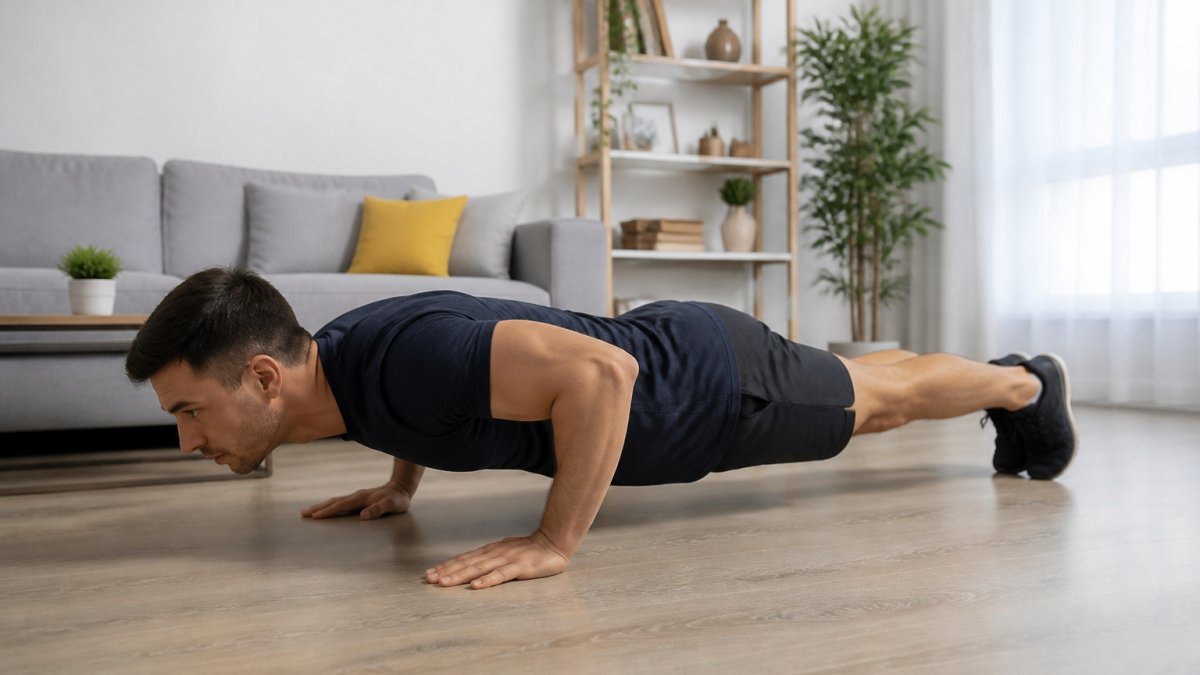
Push-ups are the foundation of upper body training.
Tricep dips use a chair or bench.
Plank holds strengthen shoulders and core. Hold a straight-body position on forearms and toes for 20-60 seconds, hips level with shoulders.
Diamond push-ups are harder than regular push-ups. Touch thumbs and index fingers into a diamond to target your triceps more intensely.
Lower Body and Core Exercises
These target your quads, hamstrings, glutes, calves, abs, and lower back.
Squats are essential for lower body strength.
Lunges work one leg at a time. Step forward, lower your back knee toward the floor, then push back up.
Single-leg exercises build stability and prevent imbalances, try single-leg squats, single-leg deadlifts, or Bulgarian split squats.
Plank variations strengthen your core from multiple angles. Try side planks, dynamic planks, or plank-to-downward-dog transitions.
30-Minute Full Body Workout at Home: Your Session Structure
A 30-minute full body workout at home fits busy schedules while challenging every muscle group and keeping your heart rate up.
Warm-Up Phase (5 Minutes)
Always warm up first, it increases blood flow and prepares your muscles. Spend 5 minutes on light movement:
- Arm circles: 30 seconds
- Leg swings: 30 seconds each leg
- Jumping jacks: 1 minute
You should feel ready to work harder, not exhausted.
Main Workout Circuit (20 Minutes)
Perform each exercise for 45 seconds, rest 15 seconds, then move on. Complete 2-3 rounds depending on your fitness level.
Round 1:
- Push-ups
- Squats
- Plank hold
Round 2 (if continuing):
- Diamond push-ups
- Single-leg squats
- Side plank (each side)
This format keeps your heart rate elevated while building strength; 45-second intervals suit most levels.
Cool-Down and Stretching (5 Minutes)
Cool down by slowing your movement and stretching, this reduces soreness and improves flexibility. Hold each stretch 30 seconds:
- Quad stretch
- Hamstring stretch
- Chest opener
Beginner Home Workout Plan: Your Weekly Schedule
A beginner home workout plan should tell you how hard to push, how to recover, and how to progress. The schedule below uses three full-body sessions per week with active recovery and rest days, muscle repair happens between sessions.
| Day | Activity | Duration | Intensity | Notes |
|---|---|---|---|---|
| Monday | Full-body circuit | 25-30 minutes | Moderate (RPE 6-7) | Main session; focus on form over speed |
| Tuesday | Active recovery | 15-20 minutes | Easy (RPE 3-4) | Walk, gentle yoga, or light stretching |
| Wednesday | Full-body circuit | 25-30 minutes | Moderate (RPE 6-7) | Main session; aim to match or slightly beat Monday |
| Thursday | Rest day | , | , | Complete rest or very light movement |
| Friday | Full-body circuit | 25-30 minutes | Moderate (RPE 6-7) | Main session; focus on controlled reps |
| Saturday | Optional movement | 20-45 minutes | Easy to moderate | Longer walk, bike ride, or recreational activity |
| Sunday | Rest day | , | , | Complete rest |
How to use RPE (Rate of Perceived Exertion): On a 1-10 scale, RPE 6-7 means you can speak in short sentences but not hold a long conversation. Chatting easily means RPE 4-5, push harder. Can't speak a few words?
Weeks 1-2: Build the habit
- Do 2 rounds of the circuit instead of 3.
- Use the easiest version of each exercise: knee push-ups, chair-assisted squats, and plank holds from your knees.
- Rest 30-45 seconds between exercises if needed.
Weeks 3-4: Add volume
- Move to 3 rounds if you completed 2 with good form and no lingering soreness.
- Add 1-2 reps per set or 5-10 seconds to plank holds.
- Reduce rest to 20-30 seconds between exercises.
Weeks 5-6: Add difficulty
- Replace knee push-ups with full or incline push-ups.
- Add a resistance band to squats or glute bridges.
- Introduce one new exercise per week, such as Bulgarian split squats or side planks.
Recovery guidance
- Sleep: Aim for 7-9 hours per night; most tissue repair happens during sleep.
- Hydration: Drink water throughout the day, not just during workouts.
- Soreness: Mild soreness for 24-48 hours is normal. Sharp pain, joint pain, or soreness lasting more than 3 days signals rest and reduced intensity.
Adaptations for small spaces and mobility limitations
- Small space: Replace walking lunges with reverse lunges in place or step-ups onto a sturdy chair. Use a towel under your hands for quieter mountain climbers.
- Knee sensitivity: Swap squats for sit-to-stands, and replace lunges with glute bridges or banded lateral walks.
- Shoulder sensitivity: Use incline push-ups on a countertop or wall, and replace overhead band presses with band pull-aparts.
Full Body Resistance Band Workout: Adding Challenge
Once you've mastered bodyweight exercises, resistance bands add difficulty without expensive equipment. They're portable, affordable, and versatile for a full body fitness at home routine. Start light and progress to medium and heavy; the 13-Piece Yoga & Pilates Set includes multiple bands at different levels, perfect for progressive training.
Upper body with bands:
- Chest press: anchor the band behind you, press forward
- Rows: anchor the band in front, pull toward your chest
- Shoulder press: stand on the band, press overhead
Lower body with bands:
- Squats with band: place band around your legs above the knees, squat normally
- Lateral walks: place band around your legs, walk sideways against resistance
- Glute bridges: place band around your thighs, push hips up
Core with bands:
- Woodchops: hold band and rotate across your body
- Pallof press: anchor band at chest height, press away from your body
- Banded planks: loop band around your back, add tension to plank holds
Bands add difficulty while staying low-impact, ideal for joint concerns or injury recovery.
Form Cues and Common Mistakes to Avoid
Proper form prevents injury and maximizes results; rushing sacrifices form for speed and raises injury risk.
Push-up form cues:
- Keep your body in a straight line from head to heels
- Lower yourself until your chest nearly touches the floor
- Don't let your elbows flare out to the sides, keep them at roughly 45 degrees
Common push-up mistakes:
- Sagging hips (core not engaged)
- Flared elbows (shoulder stress)
- Partial range of motion (reduces effectiveness)
Squat form cues:
- Keep your chest up and look forward
- Descend by pushing your hips back, not just bending your knees
- Keep your knees tracking over your toes
Common squat mistakes:
- Knees caving inward (weak glutes or poor form)
- Leaning too far forward (weak core or tight calves)
- Not going deep enough (reduces effectiveness)
Plank form cues:
- Keep your shoulders directly over your hands or elbows
- Maintain a neutral spine, don't let your hips sag or pike upward
- Engage your core by tightening your abs
Common plank mistakes:
- Sagging hips (core not working)
- Piking hips upward (fatigue)
- Holding your breath (breathe steadily)
Track Your Progress and Stay Consistent
Progress tracking turns a workout into a training plan. Without numbers, you can't tell whether you're improving or plateauing. Record enough to make one clear weekly decision: add reps, add time, add resistance, or hold steady.
What to track (and why)
| Metric | How to record it | What it tells you |
|---|---|---|
| Reps per set | Write the number for each exercise | Whether you are getting stronger or just tired |
| Hold time | Time planks and isometric holds | Core endurance and stability progress |
| Rounds completed | Note 2 or 3 rounds | Work capacity and pacing |
| RPE | Rate 1-10 after each session | How hard the session felt relative to your capacity |
| Rest time | Note seconds between exercises | Whether you are recovering faster or slower |
| Soreness | Rate 0-3 (none, mild, moderate, severe) | Whether recovery is keeping up with training |
Use a notebook, notes app, or spreadsheet, format matters less than consistency. Record the date, exercises, reps or time, and how you felt.
When to increase difficulty
Increase difficulty when you complete all prescribed reps or holds with good form for two sessions in a row and your RPE is 7 or lower. Choose one progression:
- Add reps: Add 1-2 reps per set for upper-body exercises, or 2-3 reps for lower-body exercises.
- Add time: Add 5-10 seconds to plank holds or other isometric exercises.
- Add resistance: Move from bodyweight to a light resistance band, or from a light band to a medium band.
Change only one variable at a time, add reps and resistance together and you won't know which caused the improvement or the fatigue.
A simple weekly review
Each week, spend five minutes answering three questions:
- Did I complete all planned sessions? If not, what got in the way?
- Did any exercise feel easier than last week? If yes, plan a small progression.
- Did I have joint pain or unusual soreness? If yes, consider a regression or extra rest day.
This turns consistency into progress and catches problems before a small ache becomes an injury.
What realistic progress looks like
Most beginners notice better energy and easier workouts within 2-3 weeks; measurable strength gains like more push-ups or longer plank holds show up in 4-6 weeks. Progress is rarely linear, keep the trend moving over months, not beat your best number every session.
Consistency rules that work
- Schedule it: Put workouts on your calendar like appointments.
- Lower the bar on bad days: A 10-minute session still counts.
- Pair it with a habit: Work out right after a consistent daily event, such as morning coffee or lunch.
Frequently Asked Questions
Can I get a full-body workout at home without equipment?
Yes, you can build strength and conditioning using only bodyweight exercises. Push-ups, squats, lunges, planks, and burpees engage multiple muscle groups and require no equipment. A structured routine combining upper body, lower body, and core work three to four times per week delivers measurable results. Consistency matters more than equipment, many people achieve significant strength gains through bodyweight training alone.
How long should a full-body home workout take?
A 30-minute full body workout at home is ideal for most people. This includes 5 minutes for warm-up, 20 minutes for the main circuit, and 5 minutes for cool-down and stretching. If you're short on time, even 20-25 minutes of focused exercise delivers benefits. Beginners may start with 20-minute sessions and progress to longer routines as fitness improves.
How can I make my home workouts harder as I get stronger?
Progress by increasing repetitions, reducing rest between sets, or adding resistance. Use resistance bands to add tension to bodyweight exercises like squats and push-ups. Try single-leg variations (pistol squats, single-leg deadlifts) or advanced movements (diamond push-ups, dynamic planks). Adjust your workout intensity every 2-3 weeks to prevent plateaus and continue building strength.
Can resistance bands provide an effective full-body workout?
Resistance bands offer excellent full-body training options. They target all major muscle groups, chest, back, shoulders, arms, legs, and core, while being portable and adaptable. A full body resistance band workout lets you adjust tension by changing band thickness or grip position. Bands are especially useful for seniors, travelers, and anyone with limited space, making them ideal for maintaining fitness at home or on the go.


