


Table of Contents
- What Makes a Strong X3Bar Alternative for Home Fitness
- Key Features to Look for in Resistance Equipment
- GorillaFit vs X3Bar Comparison: What Sets Them Apart
- Benefits of Resistance Bar Training for Full-Body Workouts
- Resistance Band Bar Exercises for Beginners
- Price vs. Value: Finding the Right Fit for Your Budget
- Complementary Equipment for Your Home Gym Setup
- Frequently Asked Questions
Last Updated: October 7, 2026
What Makes a Strong X3Bar Alternative for Home Fitness
Finding the right X3Bar alternatives home fitness option means understanding what makes resistance bar training effective in the first place. A strong alternative delivers adjustable resistance, durability that withstands repeated use, and portability that lets you train anywhere.
The core appeal of resistance bars is mechanical simplicity paired with effective results. Unlike machines that lock you into fixed movement patterns, a bar with variable resistance forces your stabilizer muscles to engage throughout the entire range of motion. This creates eccentric loading during the lowering phase, which drives significant muscle engagement and strength gains.
What separates a genuinely useful alternative from a gimmick is how well it handles progressive overload. You need equipment that lets you increase resistance as you get stronger, whether through variable resistance bands, adjustable tension mechanisms, or swappable components. A bar that feels solid in your hands and won't fail after three months of consistent use matters more than marketing claims.
Key Features to Look for in Resistance Equipment
When evaluating any resistance bar setup, focus on three non-negotiable dimensions: how the resistance actually works, how well it's built, and whether you can realistically store and transport it.
Variable and Linear Resistance Options
Variable resistance means the bar gets harder to move as you approach the end of the range of motion, mimicking how strength curves work naturally in the body. This is different from linear resistance, where tension stays constant throughout the movement.
Variable resistance is generally more effective for strength training because it matches your mechanical advantage. You're weakest at the bottom of a squat and strongest at the top, variable resistance accounts for this. Linear resistance, by contrast, provides consistent tension, which some people prefer for muscular endurance work or when they want predictable, controlled progression.
The choice depends on your goals. Strength-focused training benefits from variable resistance. Hypertrophy work (building muscle size) works well with either, as long as the resistance is substantial enough to create mechanical tension. Beginners often find linear resistance easier to control, which matters if you're still learning proper form.
Durability and Construction Quality
A bar's construction determines how long it will actually last. Look at the materials: swivel hooks should be reinforced metal, not plastic. The grip itself needs to resist wear from repeated hand contact. The anchor points where bands attach must handle tensile strength without degrading.
Durable construction also means the bar maintains its integrity under eccentric loading, the hardest phase for equipment. When you're lowering weight with control, you're creating enormous stress on the bar and its attachment points. Poor construction fails here first.
The best alternatives use reinforced steel or high-grade aluminum for the bar itself and heavy-duty plastic or rubber for grips. Metal swivel hooks are non-negotiable; they prevent the bands from twisting and breaking prematurely. If a product listing doesn't specify materials, that's a red flag.
GorillaFit vs X3Bar Comparison: What Sets Them Apart
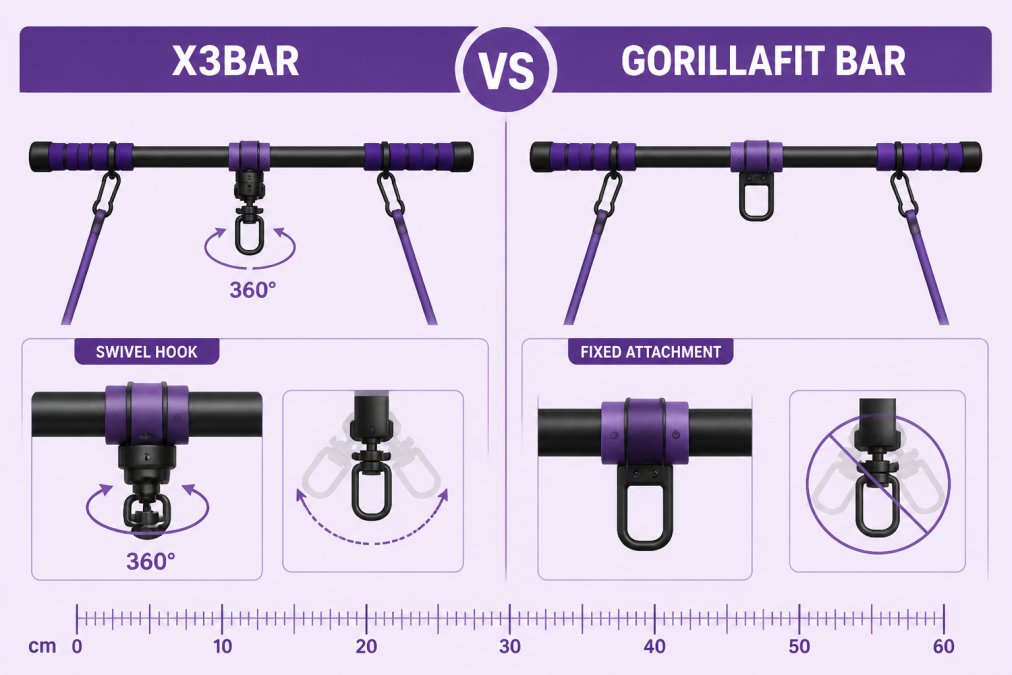
When evaluating a GorillaFit vs X3Bar comparison, the real differentiator isn't brand name, it's how each system manages variable resistance and eccentric loading through its mechanical design. X3bar uses a proprietary pulley system that attaches to a base plate, creating a resistance curve that peaks at the top of the movement. GorillaFit, by contrast, relies on a straight-bar design with band attachment points at the ends, producing a more linear resistance profile that some users find easier to control but less effective for maximizing eccentric overload.
Biomechanics: How Muscle Activation Differs
The biomechanical difference between these two systems comes down to force-angle relationships. With X3bar's pulley system, the resistance vector changes as you move, meaning your muscles must generate more force at specific joint angles, typically where you're strongest. This mimics the strength curve of free weights, where leverage improves at the top of a squat or bench press. GorillaFit's straight-bar design keeps the resistance vector constant, so your muscles work against a steady load throughout the range of motion.
This matters for muscle activation patterns. A 2020 study in the Journal of Strength and Conditioning Research found that variable resistance training produced greater activation in the pectoralis major and triceps during the lockout phase of a bench press compared to constant resistance. For home fitness users, this means X3bar-style systems may offer a slight edge for strength-focused goals, while GorillaFit-style bars are better suited for muscular endurance and joint-friendly training.
Long-Term Durability: What 6-12 Months of Use Reveals
Most reviews stop at first impressions. But after 6-12 months of consistent use, clear wear patterns emerge. On the X3bar, the swivel hooks, the metal clips that attach bands to the bar, are a known failure point. Community forums report that after 8-10 months of heavy use (4-5 sessions per week), the swivel mechanism can develop play, causing bands to twist and wear prematurely. X3bar's replacement hooks are available, but this is an ongoing maintenance cost.
GorillaFit's straight-bar design eliminates swivel hooks entirely, using fixed attachment points instead. This reduces one failure mode but introduces another: the band attachment points themselves can fray if the bar's edges aren't properly rounded. After a year, users often notice the band sleeve at the attachment point showing stress marks. GorillaFit's bands are also thinner than X3bar's, and several long-term users report a 15-20% loss in elasticity after 12 months of regular use, meaning you'll need to replace bands sooner.
Integration with Other Home Gym Gear
Neither system exists in a vacuum.
For a home gym, this integration matters. A GorillaFit bar paired with a bench and a set of bands from a reputable brand (like Rogue or Bodylastics) can replicate most X3bar exercises at a lower total cost. The trade-off is that you lose the precise resistance curve of X3bar's pulley system, but you gain versatility and easier replacement of worn components.
Price vs. Value: The Long Game
X3bar's premium price ($300+) reflects its proprietary design and included base plate. GorillaFit typically costs $100-$150 for the bar alone, but you'll need to supply your own bands and anchor. Over 3 years, the total cost of ownership may be similar: X3bar requires fewer band replacements but higher upfront cost; GorillaFit has lower entry but more frequent band purchases. If you value durability and are willing to maintain swivel hooks, X3bar wins. If you want flexibility and lower initial investment, GorillaFit is the better fit.
Benefits of Resistance Bar Training for Full-Body Workouts
Resistance bar training delivers results because it forces your entire body to work together. Unlike machines that isolate single muscles, a bar requires stabilization from your core, shoulders, and supporting muscles throughout every movement.
Progressive Overload and Mechanical Tension
Progressive overload is the principle that muscles grow when they're forced to handle increasing demands. With a resistance bar, you achieve this by adding band resistance, adjusting tension settings, or increasing reps and sets. The key is that you're creating consistent mechanical tension, the force your muscles must generate to move the weight.
Mechanical tension is what drives strength adaptation. Your muscles respond to being challenged beyond their current capacity. A resistance bar excels here because you can fine-tune the tension continuously. The tension is substantial and progressive.
Eccentric Loading and Muscle Engagement
The eccentric phase, lowering the weight with control, is where real muscle damage and adaptation happen. This is the phase that builds strength most effectively, but it's also the hardest on your equipment. A quality resistance bar handles eccentric loading without degrading, and the variable resistance actually gets harder during this phase, maximizing muscle engagement.
Many beginners underestimate the eccentric phase and rush through it. Slowing down the lowering phase (taking 3-4 seconds to lower) while maintaining tension creates significantly more muscle engagement than fast, loose movements. A well-designed bar with proper resistance mechanics makes this natural.
Resistance Band Bar Exercises for Beginners
Starting with resistance bar training doesn't require advanced fitness or experience. The movement patterns are straightforward, and the adjustable resistance means you can begin with light tension and progress naturally.
Household Abdominal Wheel Fitness Board →
Starting with Anchor Points and Joint Stability
Before you load up with heavy tension, focus on anchor points and joint stability. Anchor points are where you attach the bands, they need to be solid and positioned correctly so the bar moves in a straight line. Poor anchor points create unstable movement patterns that increase injury risk.
Joint stability means your shoulders, elbows, and wrists stay in safe positions throughout the movement. This is especially important for people recovering from physical therapy or those with limited mobility. Start with light resistance and emphasize controlled, stable movement over speed or volume. Your joints adapt to training gradually; rushing this phase invites injury.
Common Mistakes to Avoid When Starting Out
The biggest beginner mistake is using too much resistance too quickly. This forces you to compensate with poor form, which teaches your body the wrong movement pattern. Start light enough that you can complete 10-12 reps with perfect form and controlled tempo.
Another common error is inconsistent anchor points. If your bands are attached to a wobbly surface, the bar won't track properly. Spend time setting up your anchor points correctly, a solid door anchor, wall mount, or dedicated stand makes the difference between a useful workout and a frustrating one.
People also skip the warm-up phase. Resistance bars require your stabilizer muscles to work hard from the first rep. A brief warm-up with light resistance prepares your joints and nervous system for the work ahead. This takes five minutes and prevents most beginner injuries.
Price vs. Value: Finding the Right Fit for Your Budget
Most price guides for resistance bars stop at the sticker price. But the real cost of ownership includes band replacements and swivel hook maintenance. This section breaks down the true cost of each tier and offers a DIY alternative for budget-conscious buyers.
The Hidden Costs of Cheap Bars
Budget resistance bars (under $100) often use plastic swivel hooks and low-grade elastic bands. If you train 3-4 times per week, you'll likely replace the bands every 4-6 months. At $15-$25 per band set, that's an extra $60-$100 per year, quickly erasing the savings of a cheap bar.
Mid-range bars ($100-$200) typically use metal swivel hooks and thicker bands. Replacement bands cost $20-$35 per set. Over 3 years, total cost of ownership for a mid-range bar is roughly $200-$300, including replacements.
Premium bars ($200+) use reinforced steel hooks and proprietary bands. Replacement bands are more expensive ($40-$60 per set) but need replacing less often. Over 3 years, total cost is $300-$450. The premium you pay upfront is partially offset by fewer replacements, but only if you actually train consistently.
Total Cost of Ownership: A 3-Year Breakdown
| Tier | Upfront Cost | Band Replacements (3 yrs) | Hook Replacements (3 yrs) | Total 3-Year Cost |
|---|---|---|---|---|
| Budget (<$100) | $50-$90 | $120-$200 | $0-$30 (plastic hooks often not replaceable) | $170-$320 |
| Mid-range ($100-$200) | $120-$180 | $80-$140 | $20-$40 | $220-$360 |
| Premium ($200+) | $250-$350 | $60-$120 | $0-$20 (metal hooks rarely fail) | $310-$490 |
These numbers assume 3-4 training sessions per week. If you train less, replacements last longer; if you train more, they fail sooner.
DIY Alternative: Build Your Own for Under $80
If premium kits are out of your budget, you can build a functional equivalent using hardware store components. Here's a parts list and assembly guide:
- 1-inch steel pipe (24-36 inches long) from a hardware store: $10-$15
- Two heavy-duty eye bolts (3/8-inch diameter, rated for 500+ lbs): $6-$10
- Four metal carabiner clips (rated for 500+ lbs): $8-$12
- Resistance bands (a set of 5 with varying tension): $30-$50
- Door anchor or wall mount: $10-$20
Total: $64-$107. Assembly takes about 15 minutes: drill two holes in the pipe, insert the eye bolts, secure with nuts, and attach carabiners. The result is a bar that accepts standard resistance bands and provides a straight-bar resistance profile.
When to Buy vs. Build
A DIY bar works well for beginners and intermediate lifters who want to test resistance bar training without a large investment. It's also a good option for travelers who want a portable setup. However, if you're training for maximal strength or plan to use very heavy bands (100+ lbs of tension), a commercial bar with welded construction and tested swivel hooks is safer. The DIY route saves money but requires you to inspect the hardware regularly for wear.
For most home fitness users, a mid-range commercial bar offers a good balance of durability, safety, and cost. But if you're priced out of that range, the DIY approach delivers a functional alternative.
Resistance band safety guidelines from the American Council on Exercise
Complementary Equipment for Your Home Gym Setup
A resistance bar works best as part of a coordinated home gym. Adding complementary equipment expands your training options and prevents overuse injuries by varying movement patterns.
Resistance bands in different thicknesses let you adjust tension without replacing the bar itself. A yoga mat or padded surface protects your joints during floor-based exercises. Grip trainers like the PowerGrip Strength Trainer complement bar training by building forearm and hand strength, which directly improves your bar performance.
For people with limited space, the Compact Pilates Sliding Board at $274.40 provides low-impact, full-body training that complements resistance bar work. It targets core stability and flexibility, both essential for maintaining proper form during heavy bar training. The smooth sliding motion reduces joint stress while maximizing muscle engagement.
The 13-Piece Yoga & Pilates Set at $78.50 includes resistance bands, stretching straps, and a yoga ring, all useful for warm-ups, recovery, and supplemental training. This set pairs well with a resistance bar because it addresses mobility and flexibility gaps that bar training alone doesn't fill.
Choosing the right X3Bar alternatives home fitness solution means matching equipment to your actual training style, space, and budget. A durable bar with adjustable resistance, solid construction, and portability will serve you far better than chasing brand names. Focus on equipment that handles progressive overload safely, won't break under eccentric loading, and fits realistically into your home and travel routine. Health&Wellness offers several options across different price points, from grip trainers that build foundational strength to comprehensive fitness boards that deliver full-body results. Start with honest assessment of how you'll actually use the equipment, then invest in durability at the price point that makes sense for your commitment level.
Frequently Asked Questions
How does an X3Bar alternative compare to free weights for home fitness?
Resistance bars offer distinct advantages over free weights: they create variable resistance that increases tension at the top of each movement, maximizing mechanical tension and hypertrophy. Unlike dumbbells, they require no racks or heavy storage and work in confined spaces. They're safer for beginners because they provide joint stability and controlled range of motion. Free weights demand more space and coordination; resistance bars suit seated, standing, or lying positions, making them ideal for seniors or those with limited mobility seeking full-body workouts without equipment bulk.
What should I look for in a portable resistance bar for durability?
Check the tensile strength of the bands and the quality of anchor points like swivel hooks, these fail most often in budget models. Examine the bar construction: detachable bars should have secure locking mechanisms to prevent slipping during eccentric loading. Look for durable materials like reinforced PP or high-grade rubber that resist degradation over time. Read reviews specifically about long-term durability, not just initial feel. A warranty covering mechanical failure signals manufacturer confidence. The footplate and base should be non-slip and rated for your body weight plus resistance load to ensure stability during workouts.
Can I get a full-body workout with resistance band bar exercises for beginners?
Yes, resistance band bar training delivers comprehensive full-body results even for beginners. The variable resistance mechanism engages stabilizer muscles throughout each movement, creating greater muscle engagement than fixed-resistance equipment. Beginner-friendly routines target chest, back, shoulders, arms, and legs using simple anchor points and controlled concentric and eccentric movements. Progressive overload is built in: as you grow stronger, simply increase band tension by twisting the bar. The adjustable nature suits all fitness levels, and the low-impact design protects joints while building strength and hypertrophy safely.
Is a resistance bar worth the investment compared to traditional resistance bands?
Resistance bars offer superior ergonomic grip, better biomechanics for compound movements, and more consistent tension throughout your range of motion compared to loose bands. They anchor securely, reducing joint strain and improving form stability. While the 13-Piece Yoga & Pilates Set at £78.50 includes bands, a dedicated resistance bar provides barbell-simulation benefits with adjustable resistance and compact storage. For those with limited space or arthritis concerns about grip comfort, a bar's ergonomic design prevents hand aggravation. The investment pays off through durability and workout efficiency.


