


Table of Contents
- Assess Your Space and Equipment Before You Store
- Home Gym Storage Ideas Using Vertical Space
- Small Apartment Gym Storage Solutions
- Storing Specific Equipment Types
- Workout Equipment Storage Racks and Cube Storage
- Organization Tips for Renters and Budget-Conscious Buyers
- Maintenance and Safety When Storing Workout Gear
- Frequently Asked Questions
Last Updated: October 16, 2026
Assess Your Space and Equipment Before You Store
Most advice on how to store workout equipment jumps straight to products. That is backwards. The home gyms that actually work are planned on paper first. Here is a repeatable 30-minute process.
Step 1: Inventory every piece of equipment
Walk through your home and list every piece of workout gear you own. Do not trust memory, because most people underestimate by 30-50%. Group items into four buckets:
- Heavy and rigid: dumbbells, kettlebells, weight plates, benches, barbells
- Long and flexible: yoga mats, foam rollers, resistance bands, jump ropes, straps
- Bulky and awkward: exercise bikes, rowers, treadmills, adjustable dumbbells in cradles
For each item, note weight (approximate is fine), footprint when stored, and how often you use it.
Step 2: Measure the space you actually have
Use a tape measure and write down real numbers for every candidate zone:
- Wall runs: total linear feet of wall that is not blocked by doors, windows, or furniture
- Closet interiors: width, depth, and shelf height
- Under-bed clearance: typically 6-14 inches depending on the frame
People overestimate wall space and underestimate floor space. A 4-foot-wide wall section holds far more than most expect once you go vertical.
Step 3: Match equipment to storage type
Use this quick mapping to avoid buying the wrong thing:
- Heavy and rigid → floor-standing rack, reinforced shelf, or low cabinet. Never a wire hook or a lightweight pegboard.
- Long and flexible → wall hooks, pegboard, tall bin, or over-the-door organizer.
- Bulky and awkward → dedicated floor zone, wall-mounted bike hook, or a corner rack with a wide base.
Step 4: Decide your priorities before you shop
Rank these four in order of importance, because you usually cannot maximize all of them at once:
- Accessibility, how fast can you grab the item mid-workout?
- Concealment, does it need to disappear when guests visit?
- Capacity, how much weight and volume must it hold?
- Footprint, how little floor space can it use?
A renter in a studio usually ranks concealment and footprint first; a homeowner with a spare room ranks accessibility and capacity first. Write your ranking down; it settles every product decision that follows.
Step 5: Set a safety baseline
Before anything gets stored, confirm three things:
- Walkways stay clear. Leave at least 36 inches of clear path in any room you move through with weights.
- Heavy items live low. Anything over roughly 25 pounds belongs at or below waist height.
- Nothing can tip. If a rack, shelf, or cabinet can be pulled over by a child or a pet, anchor it to a stud or use an anti-tip strap.
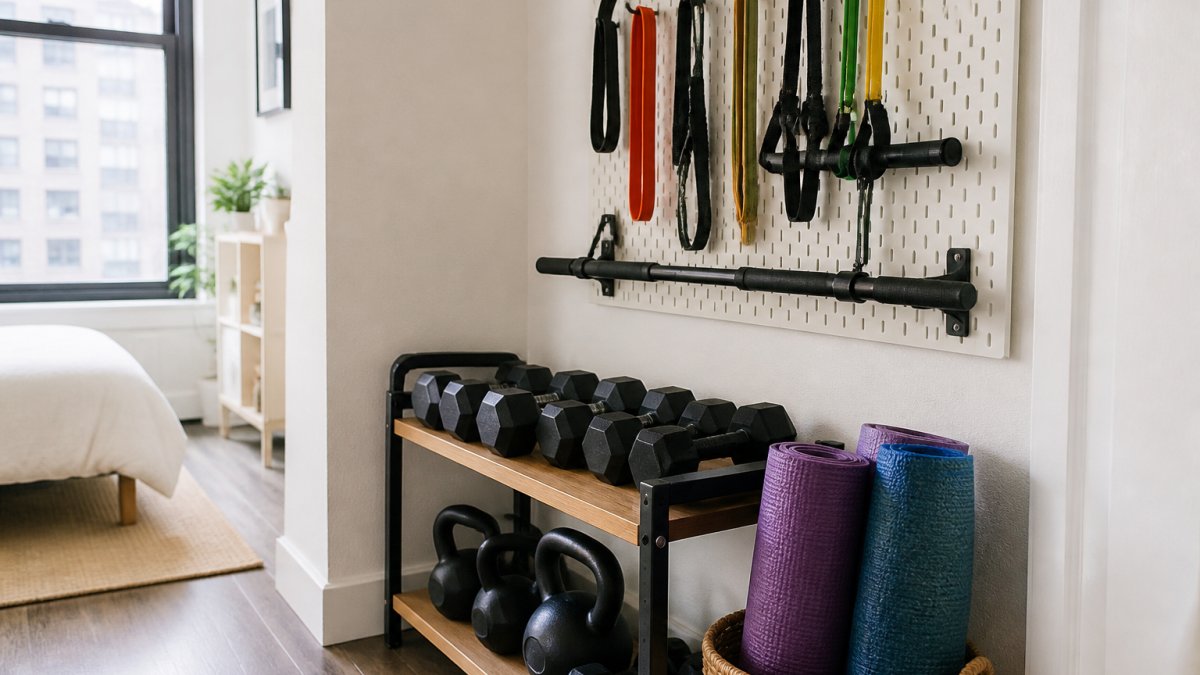
Once you have your inventory, measurements, mapping, and priorities, the rest of this guide becomes a menu of options rather than a guessing game.
Home Gym Storage Ideas Using Vertical Space
Vertical storage is your best friend in a small space. When floor space is limited, go up. Most people waste their walls and then complain they have nowhere to put their gear.
Using vertical space keeps your floor clear, makes rooms feel bigger, and keeps equipment easy to grab. Here's how:
- Install shelves for stacked items like weights and yoga mats
- Use hooks for resistance bands, jump ropes, and towels
- Add pegboards for hanging smaller equipment
Vertical storage works for almost every piece of workout equipment. The key is choosing the right wall system.
Hooks and Pegboards for Hanging Gear
Hooks and pegboards are the simplest way to store workout equipment vertically.
Pegboards are especially versatile: customize them with hooks and baskets, and rearranging takes seconds.
Here's what to hang:
- Resistance bands (all sizes)
- Jump ropes
- Hand towels and sweat cloths
Hooks suit single items you grab frequently; pegboards suit multiple pieces of varying sizes. Both are affordable and need no special tools.
Stackable Shelves and Built-In Shelving
Shelves hold more weight than hooks. Stackable shelves suit renters (no drilling); built-in shelving looks more polished if you own your space.
Shelves work well for:
- Dumbbells and kettlebells (organized by weight)
- Stacked yoga mats
- Resistance bands in bins
Organize shelves by frequency of use: daily items at eye level, heavier items on lower shelves, lighter items higher up.
For small apartments, a 3-4 shelf unit takes minimal floor space but holds significant weight; many models are only 12-18 inches deep, fitting against walls without blocking pathways.
Small Apartment Gym Storage Solutions
Small apartments have no spare room for a dedicated gym, so storage must blend into your living space without looking like a fitness warehouse.
The best approach combines methods: vertical space for hanging items, closed storage for things you don't want visible, and multifunctional furniture that hides equipment while serving another purpose.
Cabinets with Closed Doors
Closed storage hides equipment and keeps small spaces from looking cluttered.
Cabinets work for:
- Dumbbells and kettlebells
- Resistance bands
- Yoga mats
Look for adjustable shelves to customize spacing. Wall-mounted cabinets save floor space; over-the-door cabinets work in closets or bedrooms.
Closed-door storage is ideal in a studio or small one-bedroom: it keeps your space looking intentional rather than cluttered.
Multifunctional Furniture and Ottomans
Storage ottomans and benches hide equipment while serving as seating or a workout platform.
A storage ottoman can hold:
- Resistance bands
- Yoga mats (rolled)
- Foam rollers
Storage benches work the same way; some even have back support, and when not in use they look like regular furniture.
This approach is especially useful in living rooms or bedrooms where you want equipment out of sight but accessible, blending into your decor instead of screaming "gym equipment."
Storing Specific Equipment Types
Different equipment needs different storage approaches. Here's how to handle the most common items.
Storing Yoga Mats and Foam Rollers
Yoga mats take up space unrolled but compress when rolled.
Foam rollers can stand upright in a corner or hang from hooks. Avoid stacking them flat, since they compress over time and lose effectiveness.
Storage tips:
- Roll mats tightly before storing
- Use a yoga mat bag or carrier for easy transport
- Stand foam rollers upright in a corner or on a shelf
If you travel frequently, a mat carrier makes sense. At Health&Wellness, we recommend portable solutions for professionals on the go.
Storing Weights and Dumbbells Safely
Dumbbells and kettlebells are heavy. They need stable, secure storage. Never stack them unsecurely, they can fall and cause injury or damage.
Storage solutions for weights:
- Dumbbell racks: Hold weights upright and organized by size
- Shelves: Arrange weights by weight (lightest to heaviest)
- Weight storage trees: Compact stands that hold multiple dumbbells
Always organize by weight for quick selection, with heavier weights on lower shelves or racks.
Secure everything to prevent tipping. With children or pets, keep weights completely inaccessible; a falling dumbbell causes serious injury.
Resistance Band Storage Solutions
Resistance bands are easy to store but need protection from sharp objects that might tear them. Use a dedicated bin or hanging organizer.
Storage options:
- Hanging organizer: Hang from hooks or pegboards
- Bins: Group by resistance level
- Drawer dividers: Keep bands organized in a drawer
Color-coded bands make storage and selection easier. Keep them away from heat and direct sunlight, which degrade the material.
Workout Equipment Storage Racks and Cube Storage
Storage racks and cube organizers are purpose-built for workout gear: pricier than DIY solutions but more durable and organized.
A good storage rack holds multiple types of equipment. Cube storage works similarly, each cube holds different items.
Cube storage benefits:
- Adjustable dividers for different equipment sizes
- Stackable for vertical organization
- Works in any room style
Racks designed for dumbbells and kettlebells save space and organize weights in order, making selection easy during workouts.
Organization Tips for Renters and Budget-Conscious Buyers
Renters can't drill holes or make permanent changes, and budget-conscious shoppers need affordable solutions.
For renters, focus on non-permanent storage:
- Stackable shelves (no drilling required)
- Over-the-door organizers (removable)
- Freestanding racks (no installation needed)
These solutions move with you, cost less than built-in options, and work in apartments, dorms, and temporary living situations.
Budget tips:
- Start with one storage solution and expand gradually
- Use bins and baskets you already own
- Repurpose furniture for storage
The Probar-Stretchbandplus from Health&Wellness is ideal for renters and budget-conscious buyers: portable, minimal space, no storage infrastructure.
Maintenance and Safety When Storing Workout Gear
Storage is not just about tidiness. Done wrong, it shortens equipment life and creates real injury risk. Here are the safety rules most storage guides skip.
Load limits: what your storage can actually hold
Every storage product has a working load limit, and exceeding it is the most common cause of home-gym storage failures. Rules of thumb:
- Wire shelving: typically rated 200-350 lbs per shelf when evenly loaded and anchored. Weight must be distributed, not concentrated in one corner.
- Particleboard or MDF cabinets: often rated 50-100 lbs per shelf. They sag permanently under sustained heavy loads, so keep dumbbells off the top shelf.
- Wall studs: a single stud in standard wood framing can hold 50-100 lbs in shear with a proper lag bolt. Drywall anchors alone are not rated for anything heavier than a few pounds.
Tip prevention and anchoring
Freestanding racks, tall cabinets, and shelving units can tip forward if a heavy item is pulled from an upper shelf. Three habits prevent this:
- Anchor tall units to a stud with an anti-tip strap or L-bracket. Most furniture and rack manufacturers include one; use it.
- Load heavy items on the bottom. A rack with 50 lbs on the bottom shelf and 10 lbs on top is stable. The reverse is a hazard.
- Keep the center of gravity low. If a rack feels top-heavy when you nudge it, it is.
For wall-mounted bike hooks and pull-up bars, always drive hardware into studs or use a proper wall-mount plate. Toggle bolts are acceptable only for very light loads.
Ventilation and moisture
Rubber, foam, and fabric degrade faster in humid, poorly ventilated spaces. A closed closet with no airflow is one of the worst places to store yoga mats, foam rollers, and resistance bands.
- Air out closed storage by leaving cabinet doors or closet doors open for an hour after workouts.
- Avoid storing gear against exterior walls in basements, where condensation is common.
- Use a small rechargeable dehumidifier in closets that stay closed. They are inexpensive and prevent the musty smell that signals mold growth.
Material-specific care
Different materials fail in different ways. Match your care routine to the material:
- Rubber (dumbbells, mats, bands): wipe with a diluted mild soap solution, dry fully, and keep out of direct sunlight. UV causes rubber to crack and lose elasticity.
- Foam (rollers, blocks): store upright or on a flat surface with nothing pressing into them. Stacked foam compresses permanently.
- Fabric (straps, belts, gloves): wash per the manufacturer's instructions and dry completely before storing. Never store damp fabric in a closed bin.
Inspection routine
Set a monthly reminder to inspect your gear:
- Resistance bands: look for nicks, cloudy spots, or thinning. A band that snaps under tension can hit you in the face.
- Yoga mats: check for crumbling edges or a persistent smell, both signs of breakdown.
- Foam rollers: squeeze them. If they no longer spring back, they have lost their function.
Replace anything showing structural damage. A new band or mat costs far less than an injury.
If you store portable equipment like a resistance-band system, keep it in a cool, dry spot and check the bands and attachment points before each session. A two-second inspection prevents most failures.
Frequently Asked Questions
How should resistance bands be stored to keep them in good condition?
Store resistance bands in a cool, dry place away from direct sunlight and heat, which can degrade the material. Hang them on hooks or pegboards, or coil them loosely in a basket or bin. Avoid storing them in tight knots or under heavy items, as this causes creasing and weakens the band over time. The 13-Piece Yoga & Pilates Set includes multiple resistance bands that fit easily in a designated storage area or hanging organizer.
What is the best way to store sports equipment in a small apartment?
Use vertical space with wall-mounted shelves, hooks, and pegboards to maximize storage without taking up floor space. Store larger items like yoga mats in a closet corner or behind a door. Use baskets and bins to group smaller equipment together on shelves. Multifunctional furniture with hidden storage, such as ottomans or benches, keeps your home gym tidy while serving double duty. Closed cabinets with doors also help keep equipment out of sight in small apartments.
Where should you store dumbbells and weights at home?
Store dumbbells on a sturdy, low-profile storage rack or shelf to prevent damage to floors and make them easy to access during workouts. Keep them in a designated storage area away from high-traffic zones to reduce tripping hazards. For small spaces, wall-mounted racks or cube storage units work well. Always ensure the surface can support the weight, and store heavier items at lower levels for safety. Never stack weights too high or in unstable arrangements.
How do you keep a home gym organized in a small space?
Start by designating a specific storage area for your workout equipment, even if it's just a corner of a closet or one shelf. Group similar items together using baskets, bins, and labels. Use vertical storage solutions like hooks, pegboards, and stackable shelves to maximize space. Keep frequently used items, like the portable Probar-Stretchbandplus, easily accessible on a shelf or pegboard. Regularly declutter and remove equipment you no longer use to maintain an organized, functional home gym.


