


Table of Contents
- Why Full Body Workouts Work in Limited Space
- Full Body Workout at Home With No Equipment
- Full Body Resistance Band Workout
- 20 Minute Full Body Workout Routine
- Hotel Room Workout for Travelers
- Adapting Your Routine to Your Space and Equipment
- Essential Equipment for Limited-Space Training
- Frequently Asked Questions
Last Updated: October 5, 2026
Why Full Body Workouts Work in Limited Space
Full body workout limited space training suits busy professionals, travelers, and small-home dwellers, targeting all major muscle groups in one session without multiple rooms or hours of floor space.
A full-body routine compresses three gym days into one 20-45 minute workout covering chest, back, legs, core, and arms.
Limited space forces you to pick movements with the most return per square foot: compound exercises like squats, rows, and presses that work multiple joints and build total-body strength faster than isolation work.
The constraint isn't a limitation, it's focus.
Full Body Workout at Home With No Equipment
Bodyweight Exercise Fundamentals
Bodyweight exercises form the foundation of a full body workout at home with no equipment.
Progression is key: when a push-up gets easy, slow the tempo, elevate your feet, change hand position, or try single-arm variations.
Range of motion matters more than speed: controlled full-range movement activates more muscle fibers, so a slow squat to full depth beats bouncing through half-range reps.
Sample Bodyweight Routine
Here's a practical full body workout limited space routine using only bodyweight, requiring nothing but floor space:
Warm-Up (3 minutes)
- Arm circles: 10 each direction
- Bodyweight squats: 15 reps
- Inchworms: 8 reps
Main Circuit (repeat 3 rounds, 60 seconds rest between rounds)
- Push-ups: 10-15 reps (modify on knees if needed)
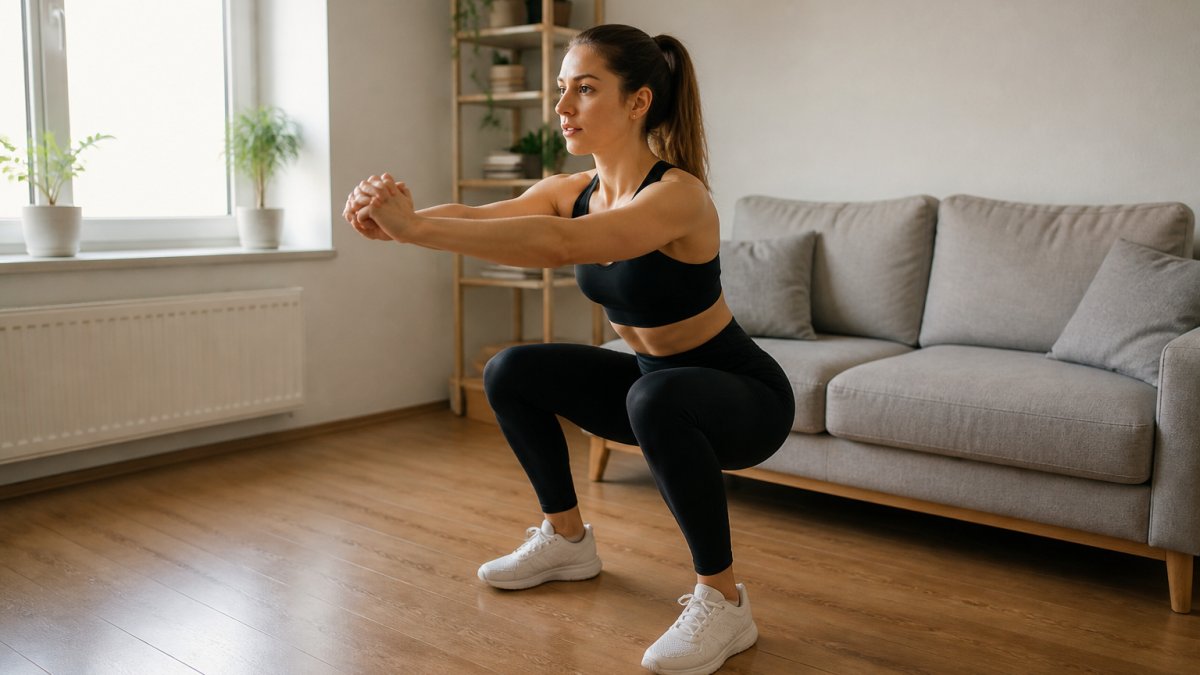
- Bodyweight squats: 15-20 reps
- Plank hold: 30-45 seconds
- Reverse lunges: 10 reps each leg
- Glute bridges: 15-20 reps
Cool-Down (3 minutes)
- Standing forward fold: 30 seconds
- Quad stretch: 20 seconds each leg
- Child's pose: 30 seconds
This hits every major movement pattern: push, squat, core stability, lunge, and hip extension. Total time: 20 minutes, no equipment, works in a dorm, hotel room, or small apartment.
Full Body Resistance Band Workout
Why Resistance Bands Excel in Small Spaces
Resistance bands are the most space-efficient training tool: they fold into a small bag, weigh almost nothing, deliver variable resistance, and are quiet and portable.
Bands increase resistance as they stretch, so the hardest point comes where your muscles are strongest, building muscular endurance in a footprint smaller than a yoga mat.
You can adjust band resistance instantly by changing grip or stance, so beginners and advanced trainees work at their own level with one piece of equipment.
Band-Based Exercise Sequences
A practical full body resistance band workout follows this structure:
Setup: Loop your band around a sturdy fixed point (door anchor, table leg) or hold it with your hands for standing exercises.
Exercise Sequence (3 sets, 12-15 reps each, 45 seconds rest between sets)
- Band chest press: standing or half-kneeling
- Band rows: pulling toward your torso
- Band squats: hold the band on your shoulders
- Band overhead press: standing, pressing upward
- Band pull-aparts: for shoulder and back activation
- Band lateral walks: for hip and glute activation
This covers all major muscle groups and movement patterns in 25-30 minutes, and the band takes up less space than a rolled-up towel.
20 Minute Full Body Workout Routine
Warm-Up and Cool-Down
Every 20 minute full body workout routine needs a warm-up and cool-down; skipping them raises injury risk and hurts performance.
Warm-Up (2-3 minutes)
- Light movement: 30 seconds of step-touches or marching in place
- Dynamic stretches: arm circles, leg swings, torso rotations
- Movement preparation: 5-10 bodyweight squats or band pull-aparts
A proper warm-up elevates heart rate, lubricates joints, and prepares the nervous system for work (pubmed.ncbi.nlm.nih.gov).
Cool-Down (2-3 minutes)
- Walk or march slowly: 30-45 seconds
- Static stretching: hold each major muscle group for 20-30 seconds
- Deep breathing: slow, controlled breaths to lower heart rate
Circuit Training Structure
The most effective 20 minute full body workout uses circuit training: move exercise to exercise with minimal rest, then repeat.
Circuit (complete 4 rounds, minimal rest between exercises)
- Squats or goblet squats: 12 reps
- Push-ups or chest press: 10 reps
- Rows or band rows: 12 reps
- Plank hold: 20-30 seconds
- Lunges: 10 each leg
Rest 60 seconds between rounds. Total time: 20 minutes including warm-up and cool-down, building strength and conditioning at once because heart rate stays elevated.
Hotel Room Workout for Travelers
Hotel rooms add three constraints home workouts don't face: a floor you don't control, shared walls, and almost no anchor points for bands. A usable travel routine solves all three.
The Noise Problem, Solved
Impact noise travels through the floor structure, so jump squats, burpees, and plyometrics are the worst offenders. The fix: replace impact with tension.
Quiet substitutions that keep the training effect:
- Jump squats → slow tempo squats (3 seconds down, 1 second up)
- Burpees → squat-to-stand with a slow push-up
- Mountain climbers → slow dead-bug or standing knee-to-elbow
A folded towel under your mat adds cushioning and dampens vibration for bodyweight movements, though it won't silence a jump.
Compact Pilates Sliding Board →
Anchoring Bands Without Damaging the Room
Door anchors only work if the door closes fully and the hinge side faces you. Two safer travel options:
- Loop the band around a closed door handle on the hinge side, then close the door. This works for rows and presses at chest height.
- Step on the band for standing presses, curls, and pull-aparts. No anchor needed at all.
Avoid looping bands around furniture legs, lamps, or TV stands, they aren't built for lateral load and can tip. If no safe anchor exists, stand on the band or hold it in both hands.
A 15-Minute Hotel Room Circuit
No equipment version (bodyweight only):
- Slow tempo squats, 12 reps
- Incline push-ups (hands on bed), 10 reps
- Reverse lunges, 8 each leg
- Glute bridges, 15 reps
- Plank hold, 30 seconds
- Dead-bug, 8 each side
Repeat 3 rounds. Rest 45-60 seconds between rounds. Total time including a 2-minute warm-up: about 15 minutes.
Band version (add a single loop band):
- Band squats, 12 reps
- Band chest press (band around back, hands at chest), 12 reps
- Band rows (anchored on door handle), 12 reps
- Band overhead press (standing on band), 10 reps
- Band pull-aparts, 15 reps
- Band lateral walks, 10 steps each direction
Repeat 3 rounds. Rest 45 seconds between rounds.
What to Pack
A single loop resistance band and a thin travel mat cover every exercise above and fit in a carry-on. If you only have room for one item, take the band, it enables the most exercise variations per ounce.
Adapting Your Routine to Your Space and Equipment
What determines whether a full body workout works in a limited space is the clearance footprint of each movement, the floor area and headroom needed to complete full range of motion without clipping furniture, walls, or fixtures. Measure once, then pick movements that fit.
Measured Clearance for Common Movements
Working estimates for an average-height adult; add roughly 10% if you're taller than 6'0" (183 cm) or long-limbed.
| Movement | Floor footprint (approx.) | Vertical clearance | Notes |
|---|---|---|---|
| Push-up (full) | 6.5 ft x 3 ft (2.0 m x 0.9 m) | none | Body length plus arm reach |
| Push-up (incline, hands on bed/table) | 4 ft x 2.5 ft (1.2 m x 0.8 m) | none | Easier and shorter than floor version |
| Bodyweight squat | 3 ft x 3 ft (0.9 m x 0.9 m) | none | Arms forward, no overhead reach |
| Reverse lunge | 5 ft x 2 ft (1.5 m x 0.6 m) | none | Step-back distance drives the length |
| Plank / side plank | 6.5 ft x 2.5 ft (2.0 m x 0.8 m) | none | Same length as a push-up |
| Glute bridge | 5 ft x 2.5 ft (1.5 m x 0.8 m) | none | Knees bent, hips lift |
| Standing band overhead press | 2.5 ft x 2.5 ft (0.8 m x 0.8 m) | 7 ft (2.1 m) | Arms extend overhead |
| Band row (anchored low) | 4 ft x 2 ft (1.2 m x 0.6 m) | none | Anchor point to chest distance |
| Wall sit | 2 ft x 2 ft (0.6 m x 0.6 m) | none | Back against a wall |
Three Space Tiers, Three Plans
Match the plan to the space you actually have.
Tier 1, Bedside area (roughly 3 ft x 6 ft / 0.9 m x 1.8 m). This is the space beside a bed or between furniture.
Tier 2, Narrow room (roughly 4 ft x 8 ft / 1.2 m x 2.4 m). You can now lie down lengthwise. Add push-ups (full or incline), planks, glute bridges, and reverse lunges.
Equipment Options by Tier
- Tier 1: Resistance band only. It stores in a drawer and needs no floor length.
- Tier 2: Resistance band plus a yoga mat. The mat defines the footprint and cushions floor work.
- Tier 3: Band, mat, and optionally a single kettlebell or adjustable dumbbell for loaded squats and presses.
A 6-Week Progression Plan
Progression isn't just more reps. Change one variable at a time, giving each change about two weeks.
Weeks 1-2, Establish the pattern. Pick one routine from the tier that fits your space.
Weeks 3-4, Add volume. Keep the same exercises but add one round to the circuit, or add 2-3 reps per set. Rest 60-90 seconds between rounds.
How Often to Train and How to Recover
Full-body training 3 times per week is the standard for limited-space routines, giving each muscle group roughly 48 hours to recover. New to strength training? Start with 2 sessions weekly for two weeks, then move to 3.
Recovery basics beat any supplement: sleep 7-9 hours, eat enough protein, and take at least one full rest day weekly.
Modifications for Common Limitations
- Knees sensitive to deep squats: Reduce depth to a box or chair, or switch to wall sits and glute bridges.
- Wrists uncomfortable in push-ups: Use fists, push-up handles, or an incline with hands on a sturdy surface.
- Lower back sensitive during planks: Shorten the hold, switch to a knee plank, or use a dead-bug variation.
General physical activity guidelines for adults
Essential Equipment for Limited-Space Training
The best limited-space equipment occupies minimal footprint with maximum versatility:
Resistance Bands (most space-efficient): Loop, therapy, or figure-8 bands cost under $20, fold into a pocket, and allow hundreds of variations.
Adjustable Dumbbells or Kettlebells: A single kettlebell or adjustable set replaces 10+ weights; 25-35 pounds suits most adults.
Pilates Sliding Board: The Compact Pilates Sliding Board creates smooth, low-impact full-body workout options in minimal space.
Yoga Mat: Not essential, but it cushions and defines your workout space, and rolls up to almost nothing.
Start with bodyweight or bands, pick one routine above, and follow it for 4 weeks.
Frequently Asked Questions
Can you build muscle with a full body workout in limited space?
Yes. Bodyweight exercises, resistance bands, and minimal equipment generate sufficient tension to stimulate muscle growth. Progressive overload, increasing reps, sets, or resistance, drives strength gains. Consistency matters more than space. Many people build noticeable strength using only a resistance band or their body weight in a small room.
What's the best equipment for a full body workout at home with no equipment needed?
Bodyweight alone is effective: push-ups, squats, lunges, and planks work multiple muscle groups. If you want to add minimal gear, a resistance band set (like the 13-Piece Yoga & Pilates Set) adds variety and intensity without taking up much room. A sliding board (like the Compact Pilates Sliding Board) enables low-impact core and leg work.
How long should a full body workout take?
Effective full-body sessions range from 20 to 45 minutes. A 20-minute workout using circuit training and minimal rest works well for busy schedules. A 30-40 minute session allows more sets and recovery between exercises. Consistency beats duration; a focused 20-minute session beats a scattered 60-minute one.
Can I exercise in a hotel room without disturbing neighbors?
Yes. Avoid high-impact moves like jumping jacks or burpees. Instead, use controlled bodyweight exercises: wall push-ups, standing leg lifts, planks, and resistance band work. Sliding board exercises are nearly silent. A portable resistance band is ideal for travel because it's quiet, lightweight, and enables full-body workouts in any room.
How do I modify exercises if I have limited mobility or arthritis?
Use seated or supported variations: chair squats, wall push-ups, or seated rows. Reduce range of motion to what feels comfortable. Resistance bands are gentler on joints than heavy weights. Start with light tension and progress slowly. If gripping is difficult, look for equipment with ergonomic handles designed for comfort.
What's the difference between a resistance band workout and bodyweight training?
Bodyweight uses gravity and your body's mass for resistance; it's free and requires no equipment. Resistance bands add variable tension that increases throughout the movement, engaging muscles differently. Bands are easier to adjust intensity, better for joint-friendly training, and more portable. Many routines combine both for balanced strength development.


