


Table of Contents
- Why a Full Body Resistance Band Workout Works
- Equipment You Need for a Full Body Resistance Band Workout
- How to Use a Resistance Bar for Full Body Workouts
- The 30 Minute Full Body Resistance Band Workout Routine
- Resistance Band Workout Routine for Travel and Small Spaces
- Progressive Overload Strategies for Lasting Strength Gains
- Common Mistakes to Avoid with Resistance Band Training
- Frequently Asked Questions
Last Updated: September 22, 2026
Why a Full Body Resistance Band Workout Works
A full body resistance band workout builds strength using elastic tension instead of gravity-loaded weights. This makes it one of the most joint-friendly ways to train, and it is the reason so many people with limited mobility or small living spaces choose it over a gym membership.
The band does not care how much you can bench press. It cares how much tension you can control.
That is the key difference. Free weights load your muscles hardest at the bottom of a lift. Bands load them hardest at the top, where the band is stretched furthest. This is called the strength curve, and it lines up well with how your muscles actually produce force.
Bands deliver that. They pack flat, weigh almost nothing, and let you train standing, sitting, or lying down.
Here is what matters most before you pick up a band:
- Low joint stress. There is no heavy bar pressing down on your spine or knees.
- Adjustable resistance. You change the load by shortening the band or switching to a thicker one.
- Constant tension. Your muscles stay under load through the whole movement.
- Portable. A full set fits in a carry-on bag.
The American Council on Exercise guide to resistance training notes that elastic resistance can produce strength gains comparable to traditional weights when the program is progressive.
That last word, progressive, is where most home workouts fall apart. We will get to it.
Equipment You Need for a Full Body Resistance Band Workout
You need very little. A loop band, a tube band with handles, a door anchor, and a small resistance bar will cover almost every exercise in this guide. Total setup space is about the size of a yoga mat.
Here is the honest breakdown of what each piece does:
| Item | What It Is Best For | Space Needed |
|---|---|---|
| Loop band | Glutes, hips, lateral movement | None |
| Tube band with handles | Rows, presses, pull-aparts | 1-2 metres |
| Door anchor | Chest press, lat pulldown | A door frame |
| Resistance bar | Full-body compound work, grip training | 1 metre |
| Light band for warm-up | Shoulder and hip mobility | None |
The resistance bar is the piece most people skip, and it is the one that changes the workout most. A bar lets you load both arms at once, which means you can train push and pull patterns with real tension instead of fighting a single band.
Bands come in different types, and this matters more than most guides admit:
- Loop bands are flat and circular. Best for glute work and lateral movement.
- Tube bands have handles. Best for rows, presses, and pull-aparts.
- Figure-8 bands sit between the two. Good for arms and shoulders.
Skip the cheapest set you can find. Bands that snap mid-row are a real safety problem, and the cost difference is small.
How to Use a Resistance Bar for Full Body Workouts
Learning how to use a resistance bar for full body workouts comes down to two things: setting the bar up correctly and choosing the right tension. Get those right and the bar handles the rest.
Setting Up Your Bar and Choosing Resistance
Start with the bar at chest height and a light band. Twist the bar to increase tension, or switch to a heavier band if the movement feels too easy.
A simple rule: you should be able to complete 10 to 12 clean reps before your form breaks down. If you can do 20 with no effort, add tension. If you cannot finish 8, reduce it.
For most beginners, the setup takes about two minutes:
- Attach the band to the bar or anchor point.
- Stand with feet shoulder-width apart.
- Hold the bar at chest height with both hands.
- Twist to set your starting tension.
- Do one slow test rep before starting your set.
Seated and Standing Variations for Limited Mobility
Seated variations make the bar usable for people who cannot stand for long periods or who are recovering from injury. The resistance does not change. Only the position does.
- Seated chest press: Sit tall, press the bar forward, control the return.
- Seated row: Anchor the band in front, pull the bar to your chest.
- Standing overhead press: Press up, keep your core braced.
- Standing hinge: Hinge at the hips, keep your back flat.
For anyone with arthritis in the hands, a wider grip can make a real difference by spreading the load across the palm instead of concentrating it on the fingers.
The 30 Minute Full Body Resistance Band Workout Routine
A 30 minute full body resistance band workout routine should hit every major muscle group, keep your heart rate up, and leave you able to train again in two days. The circuit below does all three.
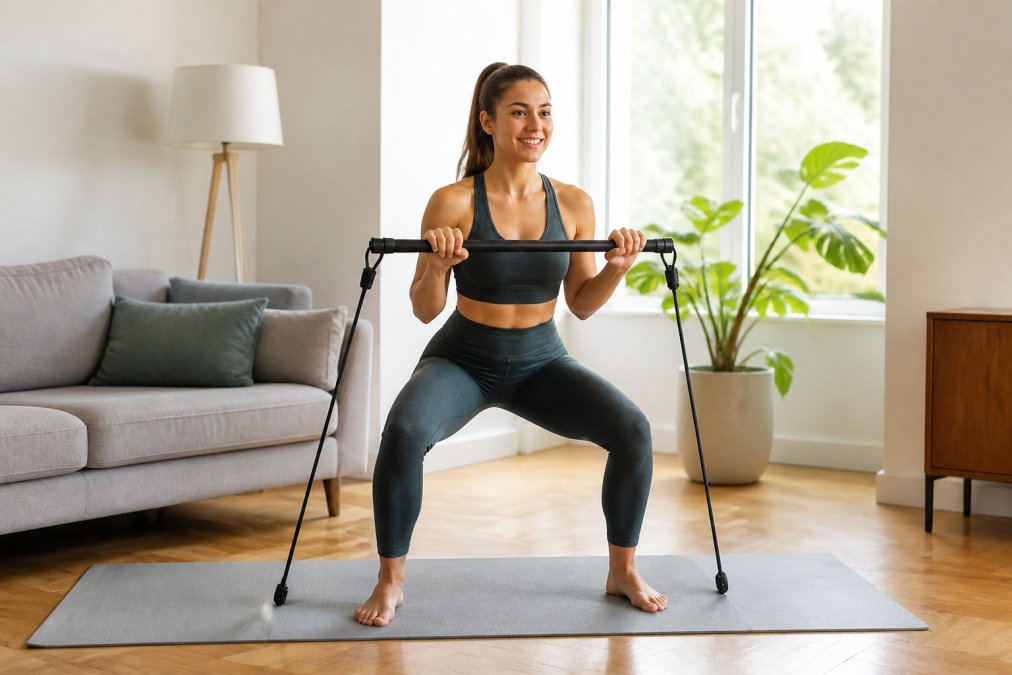
Do the circuit three times per week with at least one rest day between sessions.
Warm-Up (5 Minutes)
Warm up before you load the bands. Cold muscles and sudden tension is how people tweak shoulders.
- Arm circles, 30 seconds each direction
- Band pull-aparts, 15 reps
- Hip circles, 10 each side
- Bodyweight squats, 10 reps
- Slow shoulder rolls, 20 seconds
Main Circuit: Upper Body, Lower Body, and Core
Run through these six movements in order. Do 10 to 12 reps of each, then rest 60 seconds and repeat the whole circuit twice more.
- Band chest press (upper body push)
- Band row (upper body pull)
- Band squat or seated leg press (lower body)
- Band hip hinge (posterior chain)
- Band overhead press (shoulders)
- Band anti-rotation hold (core stability)
Resistance Band Workout Routine for Travel and Small Spaces
A resistance band workout routine for travel needs to fit in a carry-on and work in a hotel room with no furniture to spare. The bar and two bands cover that completely.
Pack this:
- Resistance bar
- Two tube bands (light and medium)
- One loop band
- Door anchor
- A small mesh bag
That is it. No shoes, no mat, no weights.
Progressive Overload Strategies for Lasting Strength Gains
Progressive overload is the single most important idea in this entire guide. Without it, you will plateau within a few weeks and wonder why the bands stopped working.
- Add reps. Go from 10 to 12 to 15 before changing anything else.
- Add a set. Move from two rounds to three.
- Shorten the band. Step closer to the anchor to increase tension.
- Slow the eccentric phase. Take three seconds to return instead of one.
- Move to a heavier band. This is the last step, not the first.
Common Mistakes to Avoid with Resistance Band Training
The biggest mistake is treating bands as a light option rather than a real training tool. Bands can build real strength, but only if you train them like you would train weights.
Here are some common errors to avoid:
- Letting the band snap back. Control the return. If the band pulls your arm back, you have lost the rep.
- Using too much tension too soon. Start lighter than you think you need.
- Skipping the warm-up. Cold shoulders and sudden band tension do not mix.
- Training the same muscles every day. Give each group 48 hours to recover.
- Ignoring the core. Anti-rotation work is not optional if you sit at a desk.
- Anchoring to unsafe points. Doors, rails, and hooks can fail.
Frequently Asked Questions
Can I do a full body workout with resistance bands?
Yes. A full body resistance band workout can target every major muscle group when you include compound movements, hinge patterns, and push-pull mechanics. Loop bands and tube bands work for squats, rows, presses, and core exercises. A resistance bar adds grip training and lets you adjust tension by twisting, which suits seated or standing routines. Most people can complete a balanced session in 20 to 30 minutes.
How often should I do a full body resistance band workout?
Two to three sessions per week gives most people enough recovery time between workouts. If you are new to resistance training or returning after a break, start with two sessions and at least one rest day in between. Muscle endurance and joint health improve with consistent practice, not daily strain. A 30 minute full body resistance band workout fits easily into a busy schedule without overtraining.
Is 20 minutes of resistance training a day enough?
Twenty minutes of focused resistance training can be enough for general fitness and muscle endurance, especially if you use compound movements and keep rest periods short. For hypertrophy or noticeable strength gains, 30 to 45 minutes two or three times a week works better because you can fit in more reps and sets. The key is progressive overload over time, not just session length.
Which resistance band is best for a full body workout?
The best option depends on your goals and mobility. Loop bands suit lower body and lateral movement work. Tube bands with handles work well for upper body pulling and pressing. A resistance bar with adjustable tension covers push-pull mechanics and grip strength in one tool, and it adapts for seated, standing, or lying positions. Many people combine a bar with one or two band types for full coverage.


