


Table of Contents
- Why Low Impact Exercises Matter for Seniors
- How to Build Grip Strength: Essential Exercises for Daily Function
- Water Aerobics and Swimming: Non-Weight-Bearing Cardio
- Senior Fitness Routine for Beginners: Getting Started Safely
- Resistance Band Exercises for Seniors: Building Strength Without Joint Stress
- Balance Training and Tai Chi: Fall Prevention and Stability
- Safety Precautions and Warm-Up Routines
- Frequently Asked Questions
Last Updated: September 27, 2026
Why Low Impact Exercises Matter for Seniors
Low impact exercises for seniors are workouts that protect your joints while building strength and endurance. These exercises reduce stress on your knees, hips, and ankles, areas that take the most wear over time.
As we age, joint stress becomes a real concern. High-impact activities like running put heavy pressure on your joints with each step. Low impact exercises for seniors avoid this problem entirely. You get the cardiovascular benefits without the joint pain.
Many older adults worry that gentle exercise won't deliver real results. That's the biggest misconception. Research shows that consistent, moderate intensity activity improves cardiovascular health, builds bone density, and maintains muscle mass, all without aggravating arthritis or other chronic conditions (Checking your browser).
The goal isn't to avoid exercise. It's to choose the right kind.
How to Build Grip Strength: Essential Exercises for Daily Function
Building grip strength is one of the most practical investments you can make for daily independence. A strong grip helps you open jars, carry groceries, and maintain balance when you need to catch yourself.
Grip strength naturally declines with age. But you can reverse that decline with targeted practice. Here's what works:
Grip strengthening routine:
- Squeeze a soft stress ball for 5 seconds, rest, repeat 10 times
- Use resistance bands twisted around your fingers for gentle tension
- Perform towel wringing exercises with a damp cloth
- Practice pinching exercises with your thumb and fingers
- Hold light objects and maintain the grip for 15-30 seconds
At Health&Wellness, we've found that the Probar-Stretchbandplus delivers exceptional results for grip training. This portable workout bar features adjustable resistance that you control by twisting. You can perform full-body exercises while seated or standing, making it ideal for seniors who want equipment that adapts to their current fitness level. The bar works whether you're at home, in an office, or traveling, no special setup required.

Start with light resistance and add tension gradually.
Water Aerobics and Swimming: Non-Weight-Bearing Cardio
Water aerobics and swimming provide cardiovascular benefits without any joint stress. The water supports your body weight completely, eliminating impact while you move through a full range of motion.
Water-based activities are ideal for seniors with arthritis or those recovering from injury. The buoyancy reduces stress on your joints while water resistance builds strength naturally.
What makes water exercise effective:
- Water provides natural resistance in all directions
- Buoyancy eliminates joint stress entirely
- Temperature regulation keeps you comfortable during longer sessions
- The environment encourages proper posture and alignment
Swimming works every major muscle group. Water aerobics classes often include walking, jogging in place, and resistance movements using flotation devices. Both options improve cardiovascular health and build functional fitness.
Start with 20-30 minutes per session, 2-3 times per week. Your body adapts quickly to water-based exercise. Many seniors progress to longer sessions and higher intensity within a few weeks.
Senior Fitness Routine for Beginners: Getting Started Safely
A senior fitness routine for beginners should start simple and progress gradually. The best routine is one you'll actually do consistently.
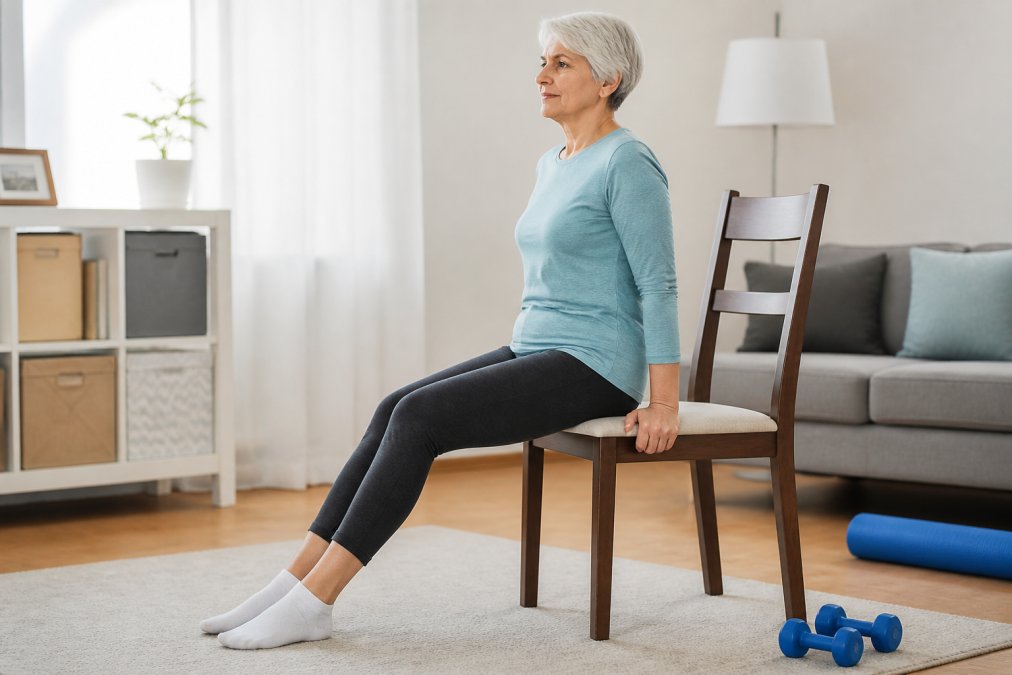
Beginner routine structure:
- Warm-up: 5 minutes of gentle movement (arm circles, leg swings)
- Main workout: 15-20 minutes of mixed exercises
- Cool-down: 5 minutes of stretching and breathing
Your first week should focus on learning proper form. Don't worry about intensity. Correct technique prevents injury and ensures you're working the right muscles.
A typical beginner session includes:
- 5 minutes of walking or marching in place
- Chair squats (10-12 repetitions)
- Wall push-ups (8-10 repetitions)
- Seated leg lifts (10 per leg)
- Standing balance work at a counter or wall
- 5 minutes of stretching
Progressive overload framework for 12 weeks:
Weeks 1-2 (Foundation): Focus entirely on form and consistency. Perform your routine 3 days per week with at least one rest day between sessions. Use bodyweight only. The goal is establishing the habit and mastering movement patterns.
Weeks 3-4 (Volume increase): Add 2-3 repetitions to each exercise. If you performed 10 chair squats, now perform 12-13. Maintain 3 sessions per week. Your body adapts to the basic movements; now you're building endurance.
Weeks 5-6 (Resistance introduction): Introduce light resistance bands or 1-2 pound objects (soup cans, water bottles). Perform the same exercises with added resistance at the original repetition count. This shift signals your muscles to build strength. Continue 3 sessions per week.
Weeks 7-9 (Intensity and frequency): Increase resistance band tension or object weight slightly. Add a fourth exercise session per week. Increase repetitions by 2-3 more.
Weeks 10-12 (Consolidation): Maintain current intensity while focusing on consistency and form quality.
Resistance Band Exercises for Seniors: Building Strength Without Joint Stress
Resistance bands offer adjustable resistance that lets you control the difficulty. Unlike weights, bands provide smooth, continuous tension that's gentler on your joints.
Resistance band exercises for seniors build functional strength for daily tasks. You can strengthen your legs, arms, chest, and back using nothing but a band and your body weight.
Essential resistance band exercises:
- Bicep curls: Hold band under your feet, curl hands toward shoulders
- Chest press: Anchor band behind you, press forward against resistance
- Leg extension: Anchor band around one ankle, straighten leg against resistance
- Lateral raises: Stand on band, raise arms out to sides
- Rows: Anchor band in front, pull toward your chest
The 13-Piece Yoga & Pilates Set from Health&Wellness includes multiple resistance bands at different tension levels, allowing you to progress as your strength improves. Start with lighter resistance and focus on controlled movement through your full range of motion.
Perform 2-3 sets of 10-12 repetitions for each exercise. Rest 60-90 seconds between sets. Your muscles need recovery time to build strength, so avoid working the same muscle groups on consecutive days.
Balance Training and Tai Chi: Fall Prevention and Stability
Falls are a serious concern for seniors (the WHO). Balance training reduces fall risk by improving stability and coordination. Tai Chi is one of the most effective approaches for building balance while being gentle on your joints. However, standard balance exercises may need modification if you have arthritis, chronic back pain, or limited mobility.
Balance training exercises:
- Single-leg stands at a counter (hold 10-30 seconds)
- Heel-to-toe walking along a line
- Standing on one leg while brushing teeth
- Tandem stance (one foot directly in front of the other)
- Weight shifts side to side while standing
Start with simple balance work while holding onto a stable surface.
Modifications for common conditions:
Tai Chi for seniors:
Tai Chi modifications for pain or mobility limitations:
- Perform movements with a narrower stance if hip or knee pain occurs
- Reduce the depth of weight shifts and squatting motions
- Keep hands lower if shoulder pain or limited overhead mobility is present
- Practice seated Tai Chi if standing for 30-45 minutes is uncomfortable
- Move at your own pace; instructors expect variation in speed and range
Safety Precautions and Warm-Up Routines
Every workout should begin with a proper warm-up and end with a cool-down. These bookend your exercise session and prepare your body for activity.
Warm-up routine (5 minutes):
- Arm circles: 10 circles forward, 10 backward
- Leg swings: 10 swings forward and back, each leg
- Marching in place: 1-2 minutes at comfortable pace
- Gentle torso twists: 10 twists each direction
- Shoulder rolls: 10 rolls backward, 10 forward
Cool-down routine (5 minutes):
- Slow walking: 2-3 minutes at easy pace
- Static stretching: Hold each stretch 15-30 seconds
- Deep breathing: 5-10 slow, controlled breaths
Safety rules for all workouts:
- Stay hydrated before, during, and after exercise
- Wear comfortable, supportive shoes
- Exercise on a stable, non-slip surface
- Keep a phone nearby in case you need help
- Avoid exercising when you're ill or extremely fatigued
- Stop immediately if you experience dizziness, chest pain, or severe shortness of breath
Frequently Asked Questions
Is it safe for a 70-year-old to start a new low impact exercise routine?
Yes, low impact exercises are designed specifically for seniors and those with limited mobility. Start with gentle movements, warm up properly, and progress slowly. Consult your doctor before beginning, especially if you have chronic conditions or are recovering from injury. Most seniors can safely perform chair exercises, water aerobics, or resistance band work with proper form and appropriate resistance levels.
Can low impact exercises help seniors build grip strength and perform daily tasks?
Absolutely. Grip strength is crucial for independence in daily activities like opening jars, carrying groceries, and holding objects securely. Resistance band exercises and portable workout tools like the Probar-Stretchbandplus are excellent for building grip strength. Regular practice improves not only hand strength but also functional ability and confidence in performing everyday tasks.
How often should seniors perform low impact exercises?
Aim for at least 150 minutes of moderate-intensity aerobic activity per week, spread across most days. For strength training, include resistance exercises 2-3 days per week with rest days between sessions. Balance and flexibility work can be done daily. Start conservatively and increase frequency as your fitness improves, listening to your body and adjusting based on energy levels and recovery.
What equipment is best for low impact senior workouts at home?
Effective home equipment includes resistance bands, sliding boards for Pilates, yoga mats for floor exercises, and portable workout bars with adjustable resistance. The Compact Pilates Sliding Board and 13-Piece Yoga & Pilates Set are excellent for full-body low-impact work. For grip strength, the Probar-Stretchbandplus offers adjustable resistance and works while standing, sitting, or lying down, making it ideal for seniors with space constraints.


